Organizational Learning Failures After Repeated Strategic Mistakes
Same project, six months apart, two different teams, one identical mistake. The first team burned through budget chasing an approach that didn't work. The second team, with no knowledge of the first, chases the exact same approach and burns through budget the exact same way. Nobody was negligent. The debrief happened, notes got filed, lessons got "captured." And none of it mattered, because none of it reached the second team before they needed it.
Leadership usually reads that pattern as a people problem: wrong hires, sloppy discipline, a team that didn't do its homework. That diagnosis is almost always wrong, and it's wrong in a specific way. Learning did happen. It just happened locally, inside one team's memory, one Slack thread, one document that got written once and never opened again. It never became something the organization could draw on. That gap between local learning and institutional knowledge is where strategic mistakes go to repeat themselves, and closing it is a structural problem, not a hiring problem.
How local learning decays before it becomes institutional knowledge
Four things drive the decay, and they compound.
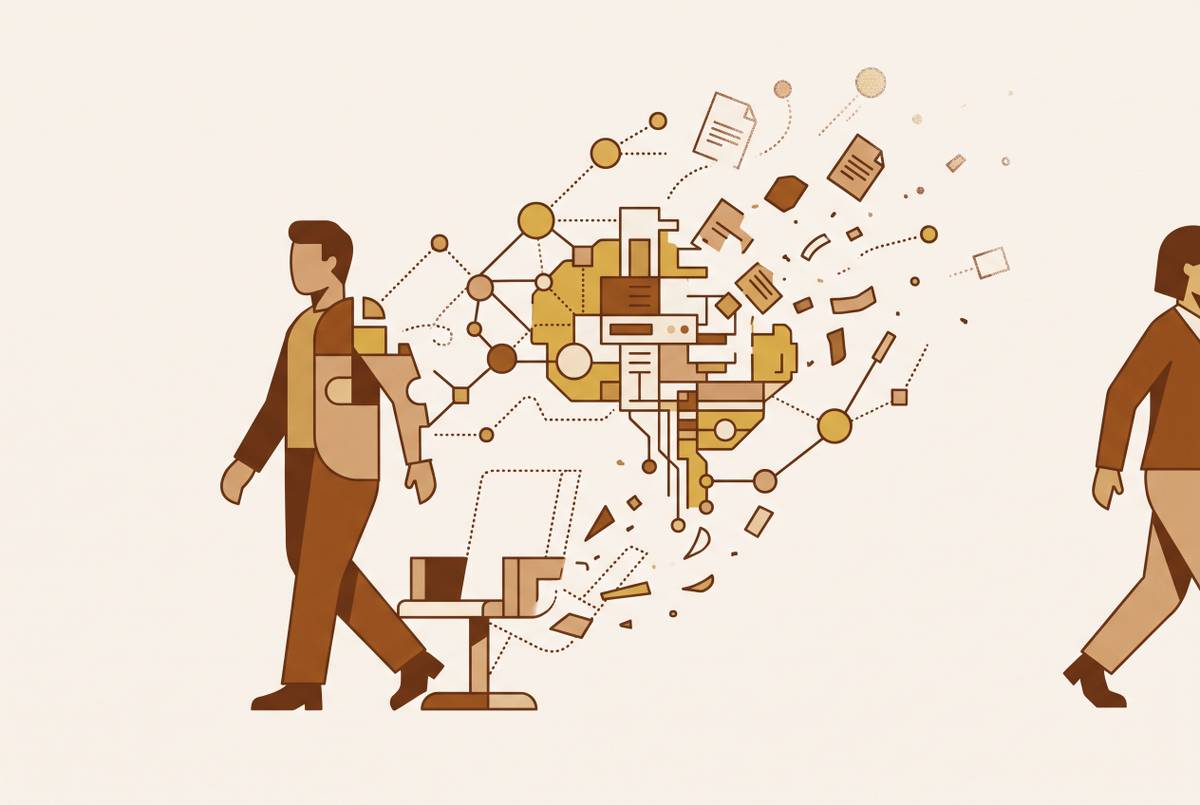
First, knowledge lives in people instead of systems. When the person who made a call leaves the company, or just moves to a different team, the reasoning goes with them. Not the decision itself, that's usually recorded somewhere, but the why. Why this approach and not the other three that got discussed. What constraint made the obvious choice impossible. That context rarely survives a departure.
Second, project reviews grade outcomes instead of decision quality. A launch that worked gets stamped "good decision." A launch that flopped gets stamped "bad decision." That's a tempting shortcut, but it trains everyone in the building to optimize for looking right in hindsight rather than reasoning well under uncertainty, and those are different skills.
Third, the lessons that do get written down aren't sitting where anyone would find them at the moment they're needed. The document exists. It's just three folders deep in a drive nobody searches, filed under a project name nobody remembers six months later.
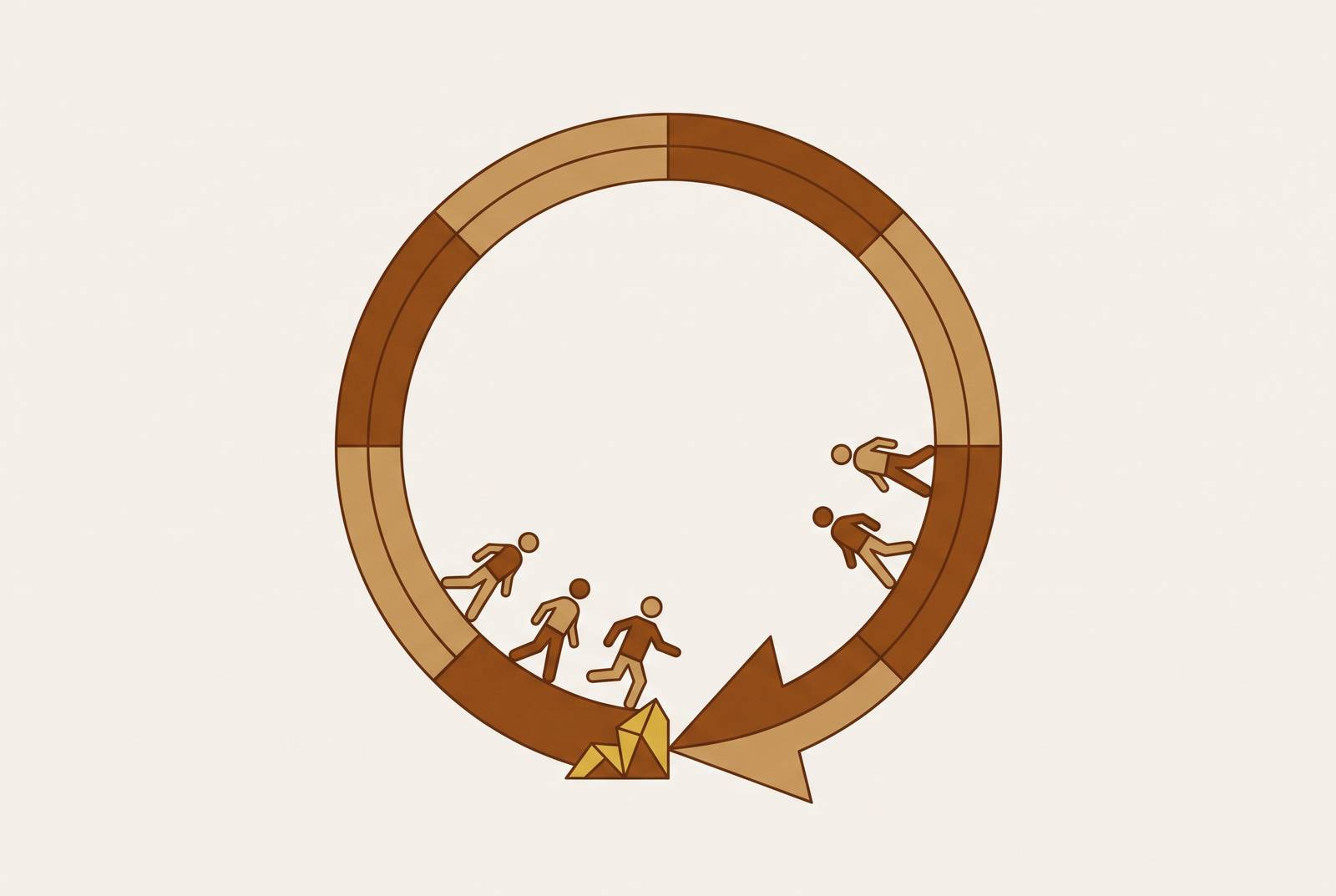
Fourth, leadership turnover resets the whole thing. New leaders arrive, look at old lessons, and decide they're "not relevant anymore," often without checking whether the underlying conditions actually changed. Researchers call this organizational amnesia, and it tends to recur on a long cycle, roughly whenever enough of the people who lived through the original mistake have moved on.
When those four are put together, the pattern writes itself: new hires get handed tasks without the trade-off history behind them, so they repeat the trade-offs. The organization implements the same fix twice, holds the same debrief twice, and reacts with the same surprise twice. The organization implements the same fix twice, holds the same debrief twice, and reacts with the same surprise twice because that's the system working exactly the way it's built to work. That's the system working exactly the way it's built to work.
What research on learning from failure shows, and where it complicates the optimistic picture
There's a comforting version of "fail forward" that says failure teaches more than success, and that version has real research behind it. Madsen and Desai's study of orbital launch vehicle programs, published in the Academy of Management Journal, found organizations do learn more effectively from failures than from successes, and that knowledge gained from failure depreciates more slowly over time than knowledge gained from success. Good news, as far as it goes.
It doesn't go all the way, though. The same research found that how much an organization can actually extract from a failure depends heavily on its prior stock of experience and on how big the failure was. A small stumble by a team with deep experience teaches differently than a catastrophic one on a team with none.
Then there's a further complication to the optimistic story. Research out of Carnegie Mellon and Clark University, published in the Strategic Management Journal, found that individual learning from failure follows an inverted curve. Performance improves as failures accumulate, up to a point, and then it declines. Attribution bias is one mechanism at work: once failures pile up and some of them genuinely were outside a person's control, people tend to attribute failure to external causes more broadly, including failures that actually were their fault. That short-circuits the learning process right when repeated failure is doing the most damage, which is a cruel bit of timing.
There's a further wrinkle for firms doing product or innovation work: organizations may find it harder to extract learning from failures that occur later in a project's lifecycle. Without a deliberate phase where the organization actually adapts its behavior based on what failed, the learning effort stalls out, and similar mistakes come back around.
Where the three-phase failure-learning cycle breaks
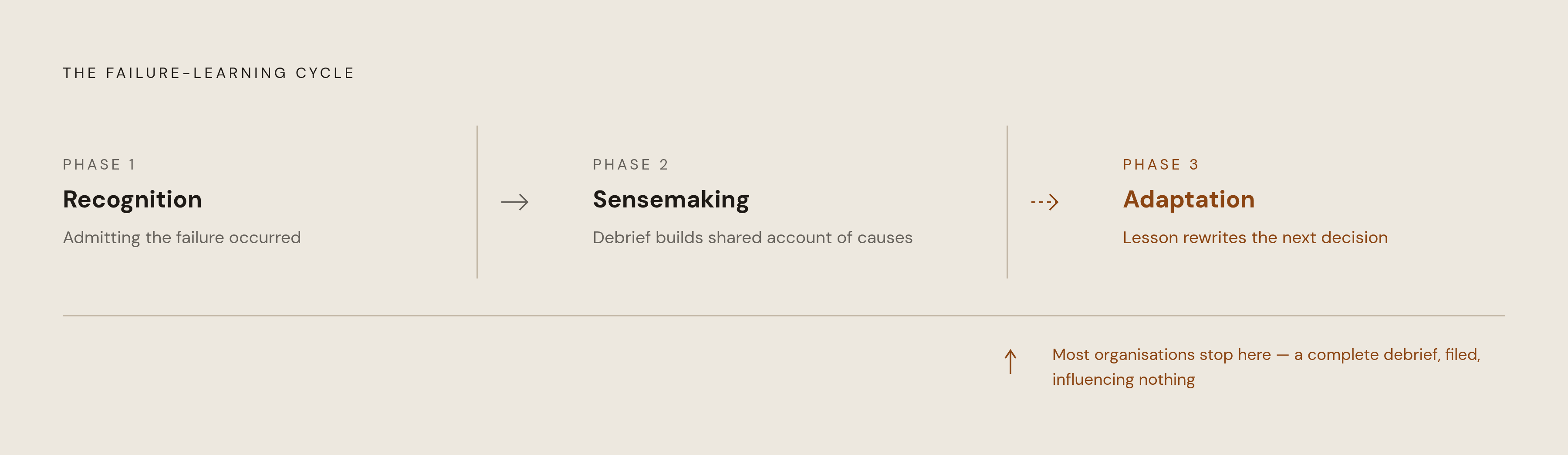
Research on knowledge-intensive organizations lays out failure-learning as three phases: recognition, sensemaking, and adaptation. Recognition is admitting the thing failed. Sensemaking is the debrief, where the team interprets what happened and lands on some shared account of the causes.
Most organizations get through both of those. The debrief happens. People argue about causes and eventually agree on a version of events. It feels productive, and it is productive, as far as it goes.
Adaptation is the third phase, and it's where the whole cycle usually stalls. Adaptation means the lesson changes how the next decision gets made. A debrief that produces consensus but doesn't touch the approval process, the checklist, or the criteria used for the next similar call has produced sensemaking without adaptation. It's a complete, well-documented record of a team understanding its own mistake, sitting in a folder, influencing nothing downstream. That's the exact failure mode from the opening: the notes get filed, and filed is where they stay.
The practical effects of separating decision quality from outcome quality
Decision quality and outcome quality are not the same measurement, and treating them as the same measurement is where most review processes go wrong.
Decision quality can only be judged using the information available at the moment the decision got made. Outcome quality reflects everything that happened afterward, including plenty that was never in anyone's control. A good decision can produce a bad outcome. A bad decision can get lucky. Reward outcomes and you don't build sharper decision-makers, you build people who avoid blame and stop documenting uncertainty, because documented uncertainty is the first thing that gets pulled up against them later.
The fix changes the first question asked in a review. Instead of starting with "what went wrong," start with "what did we know when we made this call?" Write down the information on hand at the time, the alternatives that got weighed, the reasoning behind the choice actually made, and the assumptions underneath it. Only after that context gets reconstructed does the review turn to what new information should update those assumptions going forward. Reversing the order turns the review into a hunt for someone to blame instead of a tool for getting sharper.
The contents a portable decision record needs to be useful at the next decision point
Here's a fair test for whether a decision record is worth anything: hand it to someone who wasn't in the room. Can that person check whether the conditions behind the original choice still hold, and either reuse the reasoning or update it, without redoing the whole analysis from scratch?
A record that passes that test has five things in it. The decision that got made. The context at the time, meaning constraints, data, and the alternatives actually considered. The assumptions driving the reasoning. The trade-offs that got rejected, and why. And the conditions that would justify revisiting the whole conclusion later.
Records fail the test constantly, and they fail it in a consistent way: they capture the conclusion without the context, the outcome without the reasoning, the lesson without the decision conditions that made the lesson relevant. "We decided not to expand into that market" tells the next team nothing. "We decided not to expand because unit economics required a 20% price premium the local competition wasn't going to allow, and that constraint might not hold anymore" tells them everything.
None of that matters if nobody can find the record when they need it. A lesson buried three folders deep is, functionally, no lesson. Accessibility at the moment of decision is the entire point of documentation. It's the entire point of documentation.
How siloed systems block decision context from reaching the people who need it
Picture the systems tracking one person through an organization: an application history in one platform, licensing or training progress in another, support interactions in a third, performance records in a fourth. Each one holds a slice of that person's story. The reasoning behind a past decision about that person, the why behind a call someone made six months ago, often lives in none of them.
A decision record sitting in a project management tool doesn't reach the CRM. A hard-won lesson in a shared drive doesn't surface inside the workflow where the next nearly identical decision is happening right now. New hires get handed logins to every one of these systems, and what they get is the data. What they don't get is the judgment that shaped it, because that judgment was never attached to the record in a way any system could carry forward.
Connecting context across silos doesn't mean piling every record into one giant database and hoping meaning falls out of proximity. It means linking what specific data points actually mean for the same workflow, the same person, the same decision, so the relationships between records are legible to whoever's looking.
What it takes to make past reasoning govern future action, not just inform it
There's a real difference between a lesson someone can consult and a lesson that actually shapes what happens next. A lesson filed away for reference depends on someone remembering it exists, remembering where to look, and choosing to look, right at the moment they're under deadline pressure and drowning in volume. That's exactly the condition under which people don't go check.
Governing future action, rather than merely informing it, takes a few specific things.
Decision traces that tie together the evidence available, the reasoning applied to it, the human judgment exercised, any approval or override that happened, the action ultimately taken, and the outcome that resulted. A separation between read access and write access, because seeing a past decision and being able to edit that record are different permissions carrying different accountability. Named ownership of exceptions, so that when current conditions drift from the conditions that made an old lesson true, a specific person has the authority to decide whether the lesson still applies. And conditions for reuse built into the workflow itself, so the system checks whether circumstances have changed before letting a prior lesson get applied blindly to a new call.
Handled this way, institutional memory becomes a governance artifact rather than a documentation artifact. The record of what got decided, why, by whom, under what constraints, and with what result becomes an actual input into the next decision's approval structure. That changes what leaders can rely on. A structure that surfaces context automatically replaces the need for individuals to remember and relay it by word of mouth. Turnover erases a relationship, but a structure that captures reasoning in records rather than people can survive it.
The role of AI-connected systems in closing the gap between documented lessons and active decisions
The core problem established by all of this isn't a shortage of lessons. Organizations generate plenty of lessons. Those lessons aren't accessible inside the exact context where the next decision is being made, at the exact moment someone needs them.
AI-connected workflow systems address that gap directly, by pulling together structured and unstructured data scattered across silos, business records, documents, past decisions, prior human corrections, and surfacing the relevant piece of it right as a new decision is forming. That's a different job than search. Search requires someone to know a lesson exists and go looking. Surfacing means the system recognizes the workflow or the entity in front of it and brings the prior reasoning along automatically.
A context graph is the infrastructure that makes that possible: connecting what different data points mean for the same workflow or the same entity across separate systems of record, so a new team tackling a familiar problem sees the reasoning that came before, without needing to know that reasoning exists or where anyone filed it. Decision traceability is what comes out the other end. Every consequential decision leaves behind a record of what information was available, what reasoning got applied to it, whether a human reviewed or overrode it, and what actually happened as a result. That record becomes the raw material the next similar decision draws on.
Starting with one workflow, one owner, and a measurable baseline before scaling the learning infrastructure
Organizations that actually manage to turn failure into institutional knowledge, rather than just a folder of debrief notes, don't try to fix everything at once. They start in one bounded workflow, where the baseline is clear, the outcome is measurable, and someone specific is accountable for both.
That single workflow needs a few things in place before it can generate real institutional learning. A named owner who can say what the current process does, what a better version of it looks like, and how "better" gets measured. An agreed baseline, captured before anything changes: what the process produces today, at what cost, with what error rate or exception frequency. A defined measurement window, with one named person responsible for reading the results against that baseline once the window closes. And decision traces running from day one, so the reasoning applied during the pilot becomes the organization's first real deposit into institutional memory, not an afterthought bolted on later.
A single workflow with a clear owner and a measurable outcome is the right place to start precisely because it lets the organization prove the infrastructure works before anyone has to depend on it for something bigger. It also produces the first genuinely traceable lesson, the one future decisions can actually pull from.
From there, the effect compounds. Every new workflow adds another piece to the context graph. Each decision trace extends the running record of what was known and what happened as a result. Each measured outcome hands the organization evidence it can use, rather than another well-intentioned lesson that got documented once, filed away, and forgotten by the time the next team needed it most.
Sources
- Tepper School Study Finds Not All Failures Lead to Learning
- Decomposition of double-loop failure risk in post-innovation failure phase - ScienceDirect
- Embracing the “fail fast and learn fast” mindset: conceptualizing learning from failure in knowledge-intensive SMEs | Small Business Economics | Springer Nature Link
- Failing to Learn? The Effects of Failure and Success on Organizational Learning in the Global Orbital Launch Vehicle Industry | Academy of Management Journal