Knowledge Loss During Executive Succession
Most organizations lose 70% of critical knowledge when experienced leaders depart.
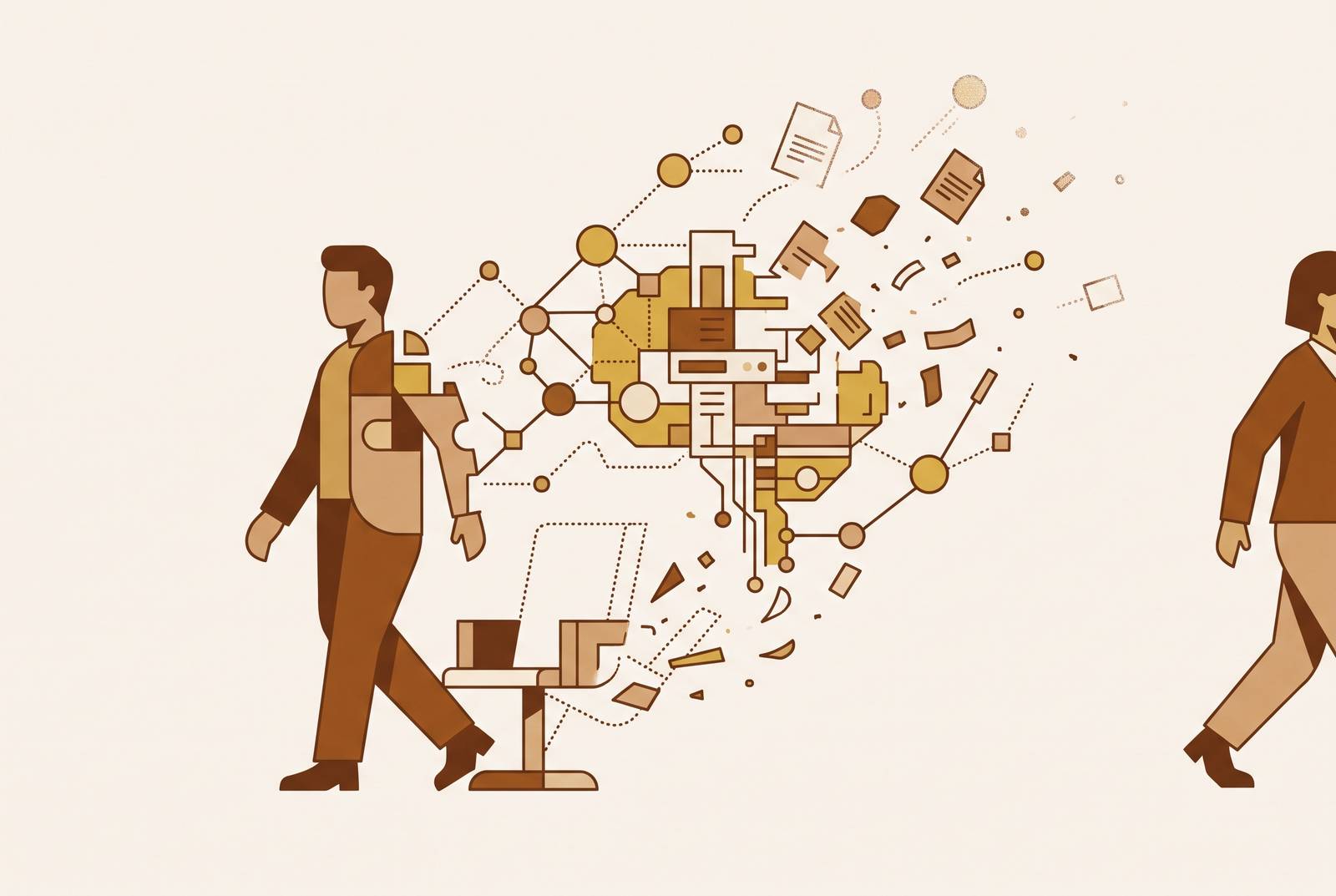
Executive turnover hit its highest first-half total since Challenger, Gray & Christmas began tracking the number in 2002, and Q1 2025 alone came in 4% above Q1 2024. The departures are visible. What isn't visible is the knowledge walking out alongside them, because most organizations built succession plans for the org chart, not for the reasoning that sat inside the person who used to occupy the box. Those are two different problems, and treating them as one is why so many transitions look fine on paper and fall apart in practice.
Even where succession is taken seriously at the top, 37% of CHROs still call organization-wide succession planning a significant challenge. The retirement wave makes the gap worse: 69% of government agencies expect more than 5% of their workforce to retire within five years, yet 61% have no formal succession process. Succession planning answers who sits in the seat next. It says nothing about whether that person can think the way their predecessor thought, with the same context, the same scar tissue, the same feel for which relationships mattered. That's a knowledge problem, not a staffing problem, and it needs its own fix.
What the departing executive carries out the door
Institutional memory sits in three layers. Explicit knowledge lives in wikis, manuals, and shared docs, the stuff that's already written down and searchable. Tacit knowledge lives in people's heads, built through years of trial, error, and pattern recognition. Embedded knowledge is stranger still: it's baked into culture, habits, and the informal workflows nobody bothered to document because "that's just how things get done here." Most enterprise knowledge management tools only touch the first layer. APQC's benchmarking work, widely cited in knowledge management research, puts tacit knowledge at 70 to 80% of what an organization actually knows, so the overwhelming majority of what an executive carries around in their head was never structurally visible to anyone else in the first place.
Four things leave when the executive does. Decision rationale is the first and most costly: not the decision itself, which usually gets recorded somewhere, but the alternatives that were weighed and the specific reasons they got rejected. Relational capital is second, the trust built with a regulator, a key vendor, or a longtime client that attaches to the person, not the title on their badge. Third is contextual judgment, the instinct for which policies are load-bearing and which have quiet exceptions, and which stakeholder needs to be handled with care versus which one can be told no directly. Fourth is failure memory: the bets that didn't pan out, the pilots that went nowhere, the deals that almost happened and didn't, all of which quietly calibrate how much risk the organization is willing to take on next time.
Not all of that should survive the transition intact. Some of what looks like a "critical process" is really just one person's workaround for a broken system, kept alive because they personally knew how to route around it. A successor who inherits the behavior without the backstory just inherits the dysfunction, dressed up as best practice. Capturing knowledge isn't the same as preserving every habit uncritically; it means preserving enough context that someone can tell the difference.
The knowledge loss that happens before the departure, not during it
The damage is usually done long before anyone hands in a resignation letter. Employees spend something like 11.8 hours in meetings, and only 37% of those meetings end with an actual documented decision. The reasoning behind most strategic calls simply never gets written down anywhere a successor could later go find it. It evaporates the moment the meeting ends.
AI note-takers were supposed to fix this, and to some degree they've caught on fast across organizations of every size. But most stop recording the moment the meeting does. The hallway conversation where the real objection got raised, the whiteboard session where the actual model got sketched out, the informal call where someone talked a VP off a bad decision, none of that gets touched by a note-taker sitting in a calendar invite.
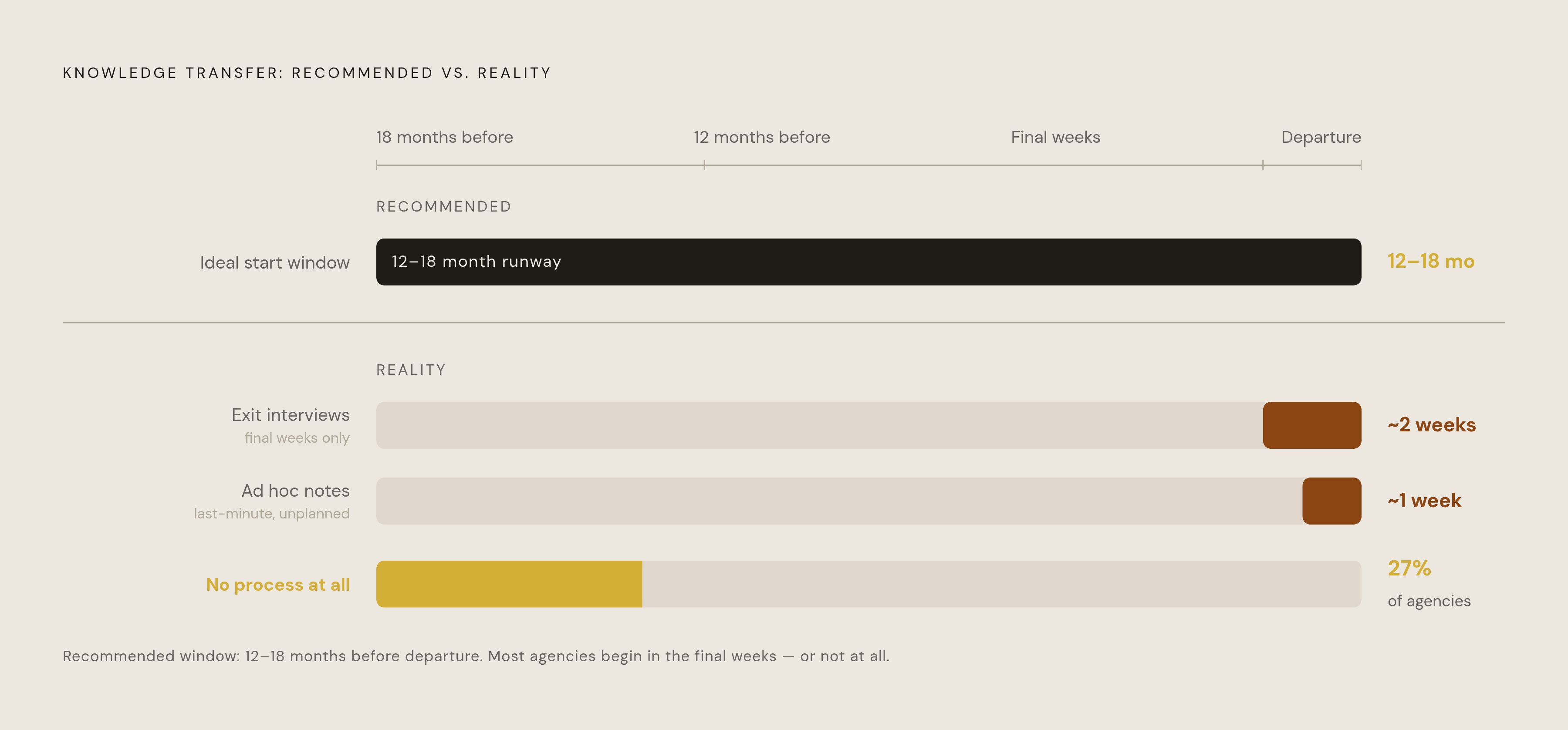
Then there's the exit timeline itself, which is almost always too short to matter. NEOGOV's HR Trends Report found that 27% of agencies have no clear knowledge transfer process at departure whatsoever, and among the agencies that do have something, most lean on exit interviews or ad hoc documentation instead of any structured cross-training. Knowledge transfer that actually works needs to start 12 to 18 months before a departure is expected.
The financial and strategic cost of doing nothing
The productivity drain alone is staggering. Large companies in a major economy. companies lose an average of $47 million tied to knowledge workers spending roughly 5.3 hours a week waiting on information or rebuilding something that already existed somewhere, undocumented, inaccessible, or simply forgotten.
Turnover costs compound the problem at a national scale. Gallup's estimate put voluntary turnover at $1 trillion annually for employers in a major economy. organizations, still the most comprehensive figure of its kind. Replacing a knowledge worker runs 50 to 200% of their annual salary, and new hires typically need 8 to 12 months to reach full productivity, a ramp-up period driven in no small part by undocumented institutional context they must piece together from scratch. Add to that the fact knowledge workers spend roughly 19% of their time just searching for information they should already have access to, nearly a full workday every week, and the picture gets uncomfortable fast. None of this is a one-time cost that hits on departure day. It's a recurring tax the organization pays for as long as the knowledge stays undocumented.
The layer below the C-suite: where succession planning is weakest
Everyone watches the C-suite. Almost nobody watches the layer just beneath it, and that layer is where the structural weakness sits. 86% of leaders call succession planning urgent or important, but only 14% think their own organization executes it well. That gap is about follow-through, and follow-through is precisely what breaks down once you move past the executive team. It's about follow-through, and follow-through is precisely what breaks down once you move past the executive team.
92% of HR executives say people managers are critical to overall organizational success, yet succession planning for that tier gets a fraction of the structure and attention that C-suite planning receives. Gallup's research attributes 70% of the variance in team engagement directly to the manager. Lose that manager without a plan, and the damage doesn't stop at an unfilled box on the org chart, it travels straight into team morale, execution speed, and the pace of everything downstream. Middle managers carry a specific, underrated kind of knowledge: which vendor rep actually picks up the phone, which legacy system has a workaround nobody wrote down, how the team really operates day to day, why certain projects got prioritized over others, and which stakeholders need extra handling. None of that appears in a job description. All of it disappears the day the manager leaves, unless someone deliberately built a way to keep it.
Conventional knowledge transfer methods that fail to capture what matters most
Exit interviews, job shadowing, written documentation, informal mentoring: these are the tools most organizations reach for, and they're also the least equipped to capture tacit or relational knowledge. Only 33% of agencies offer mentoring at all, only 28% offer job shadowing, and 17% offer no development opportunities whatsoever. Just 56% of agencies offer in-person training of any kind, and structured, hands-on knowledge transfer is the exception rather than the norm.
Exit interviews have a built-in filter problem. They capture whatever the departing employee happens to think of, filtered through what they choose to mention, filtered again through the time pressure of a brief conversation scheduled during their last week. The knowledge that's become so second-nature it no longer registers as "knowledge" to them, the stuff they'd never think to bring up because it feels obvious, is exactly the knowledge that disappears without a trace.
Documentation has its own blind spot. It records what got decided. It almost never records what got considered and thrown out, which relationships had to be worked to get the decision approved, or what would have happened had the vote gone the other way. A decision without its rejected alternatives is a conclusion stripped of its reasoning, and a successor working from that conclusion alone is flying blind the moment circumstances shift even slightly from what they were when the original call got made.
Making decision reasoning capturable before someone walks out
Knowledge that exists only in someone's memory is individual knowledge with an expiration date attached, and the date is whenever that person's last day happens to fall. It's individual knowledge with an expiration date attached, and the date is whenever that person's last day happens to fall.
Making reasoning capturable means something specific in practice. Decisions need to be recorded with their rationale attached, including the alternatives that were on the table, the assumptions baked into the call, and the specific stakeholder judgments that tipped the outcome one way rather than another. Relationships need to be mapped with context: who the person is, why the relationship matters, what they care about, and what history exists between them and the organization. Failed and inconclusive outcomes need to sit right alongside the successes, because the bet that didn't pay off often teaches more about current risk tolerance than the one that did. And none of this can live in isolated documents scattered across a drive somewhere. It needs to connect, so a successor looking at today's problem can trace it backward to the decision that actually created it.
This is where knowledge management as an industry has quietly shifted. As of 2026, the hard problem in enterprise knowledge management isn't filing anymore, it's intelligence infrastructure: agentic AI workflows and semantic retrieval are redefining how organizations capture and act on what they know. What's been missing, as knowledge management practitioners have come to recognize, is a persistent, versioned, governed record of what the business has actually decided is true. Practitioners and analysts have increasingly pointed to context drift and memory loss during multi-step reasoning, not shortfalls in the underlying models themselves, as the primary failure mode. The models were fine. The memory wasn't there to feed them.
The technology infrastructure that makes decision reasoning persistent
The enterprise knowledge graph market reached a substantial valuation in 2026 and is growing at a 21.3% CAGR through 2033, pushed forward by demand for AI explainability, semantic data fabrics, and decision intelligence that works across functions instead of staying trapped in one department's tools.
A knowledge graph does something a document repository structurally cannot. It models organizational knowledge as a network of typed entities and relationships, governed by an ontology, which lets a system reason, infer, and answer context-aware questions across data sources that would otherwise sit in silos. Query a document repository and you get a document back. Query a knowledge graph and it traverses the network, returning the surrounding subgraph of related facts, decisions, and relationships as context.
That's the architecture behind GraphRAG, which by 2026 has become the standard production approach for retrieval-augmented generation built on a semantic knowledge backbone. It lets AI agents pull from a trusted, continuously updated web of facts instead of relying purely on whatever's baked into a model's raw parameters. After years spent racing toward the largest, most powerful models available, enterprises are landing on a less flattering but more useful realization: scale by itself doesn't create value. Context does, and context has to be built, maintained, and kept current, or it decays the same way an unmaintained wiki does. Gartner's prediction that more than 50% of AI agent systems will rely on graph-based context signals a shift already underway. It's confirmation that context persistence is already becoming the standard the rest of the industry is building toward, whether a given organization has started or not.