Why Most Mergers Fail After the Deal Closes (Post-Merger Integration)
Mergers fail when companies lose the unwritten knowledge that makes them work.

Most mergers fail not because the strategy was wrong. They fail because the two companies never figure out how to work as one after the deal closes. The root cause is almost always the same. Knowledge built up over years gets lost in the gap between two organisations that were never designed to share it.
Why most mergers fail after signing, not before
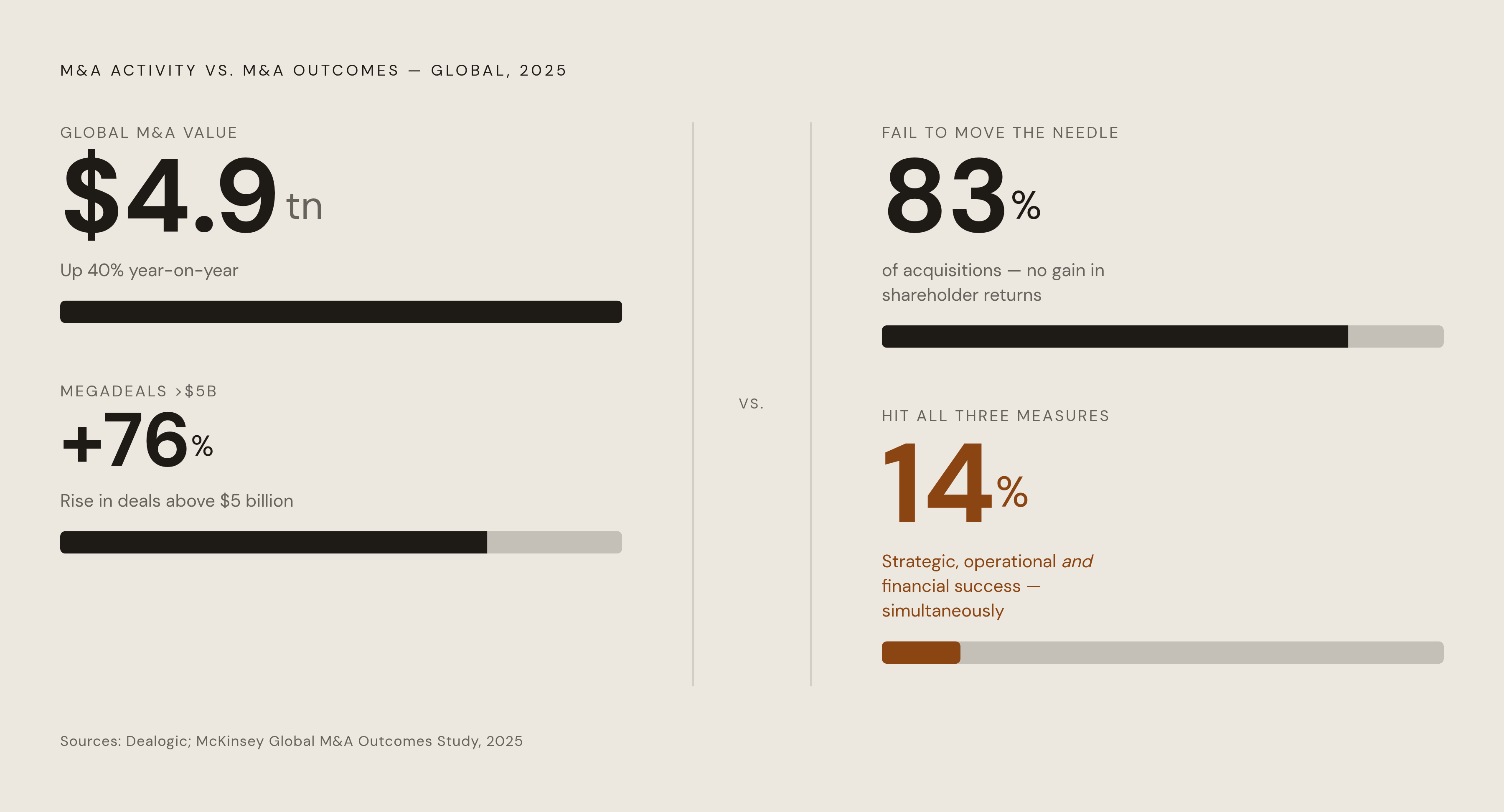
Global M&A value jumped more than 40% in 2025. It reached $4.9 trillion. The biggest deals above $5 billion rose 76% over the year before https://pmistack.com/blog/post-merger-integration-statistics https://transjovancap.com/feeds/blog/post-merger-integration-news. That is a lot of money chasing mergers. The outcome numbers make that hard to explain away.
Some 83% of acquisitions fail to improve shareholder returns. Only 14% hit real success across strategy, operations, and finances at the same time https://pmistack.com/blog/post-merger-integration-statistics https://transjovancap.com/feeds/blog/post-merger-integration-news. When practitioners are asked why, they point to poor execution after the deal closes. They do not blame a flawed plan or a bad target.
The usual explanations are mostly wrong. Paying too much, culture clash, reaching past your area of expertise — none of these is the main cause. Failure happens in the months after signing. It happens in the room where two organisations try to start acting like one. That is an execution problem. Execution problems have a specific cause.
What "institutional memory" means and why it matters in a merger
Institutional memory is the knowledge built up inside an organisation over time. It is the context, judgement, and process knowledge that lets someone make a decision without rebuilding the whole backstory first. Every working company runs on it, mostly without naming it. It is knowing who actually has the answer. It is knowing which system holds the record everyone trusts. It is knowing which exception got approved last year and why. It is knowing which steps in a process matter and which are just old habits nobody has dropped.
A merger does not combine two versions of that memory into one bigger one. Instead, it creates two separate, incomplete bodies of context running side by side. Neither maps cleanly onto the other. The people who carry that knowledge are distracted, uncertain about their futures, or already gone by the time anyone needs to ask them a question.
Academics who study post-merger integration — Heimeriks, Huy, and Vaara among the most cited — describe the work as three overlapping processes: fitting strategies together, blending cultures, and learning as an organisation. Institutional memory runs through all three. But it is rarely named as the connecting thread. That is part of why it keeps getting dropped.
Where knowledge breaks down first after a merger
Day One gets all the attention because it is visible. Systems get switched on, badges get reissued, and press releases go out. The real damage is quieter and slower. It builds up over weeks. Joint decisions get made against incomplete information that nobody flagged as incomplete.
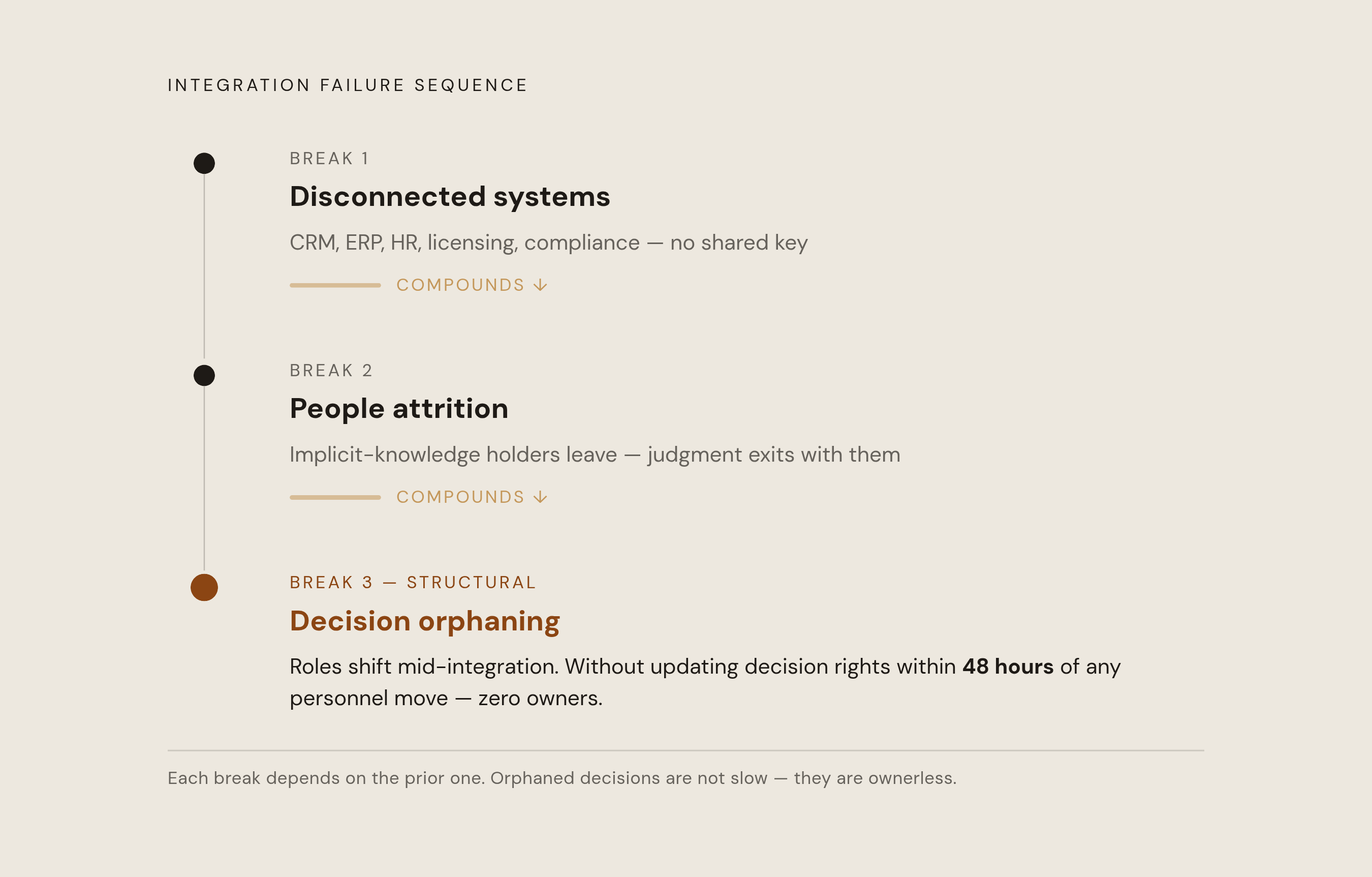
Poor execution after a merger creates three breaks. They appear early in almost every integration.
The first is disconnected systems. Customer relationship tools, finance platforms, HR systems, licensing records, and compliance tools each use their own identifiers. The same customer, agent, or policy has a different ID in every system. There is no shared key linking any of them.
The second is people leaving. The employees who hold the unwritten context — who know an approval was an exception rather than the rule — leave early. They leave by choice or by layoff. Their judgement leaves with them.
The third is decisions with no owner. Roles shift constantly mid-merger. Unless it is clear within 48 hours who owns a decision after any personnel change, that decision can end up with no owner at all. Not a slow owner. Not a distracted one. No owner at all.
Insurance makes the stakes concrete. Financial institutions announced more than 2,000 deals across most of 2025 https://www.wtwco.com/en-us/insights/2026/02/the-2026-m-and-a-landscape-for-financial-institutions. A team without a connected view of both companies' licensing data misses filing changes as they happen. A missed licensing deadline is a compliance exposure with a regulator's name on it.
The quieter cost appears in approvals. Somewhere between 40% and 75% of approval steps in a typical large company add no real value https://pmistack.com/blog/post-merger-integration-statistics. Often the person signing off lacks enough background to do anything except rubber-stamp the request or pass it up the chain. That is not a staffing problem. It is knowledge that never reached the person approving.
How the management structure either protects or destroys institutional memory
The Umbrex PMI Playbook describes the Integration Management Office (IMO) — the team that runs the merger day to day — as the programme's control tower. It has the authority to line up resources, resolve conflicts, and call time-outs when execution drifts from the original plan. Without a written charter, that office slides into producing status updates nobody reads. The charter acts as the integration's institutional memory. It is the one document that says, in writing, why the IMO has the authority it has and what it is supposed to protect.
A decision-rights matrix is a document that spells out who owns which decision. It works the same way — as a memory record, not a bureaucratic form. The Umbrex playbook recommends naming individual owners for each decision type, not committees. Back that up with a responsibility chart, a decision log with timestamps and the reasoning behind each call, and an escalation path with clear numeric triggers rather than vague thresholds.
Five principles from that playbook protect institutional memory directly. Focus on what matters most: write down the roughly 20% of choices that drive most of the value. Let everything else follow the normal chain of command. Push decisions down to whoever is closest to the problem. Set escalation triggers in advance. Name one person who decides — committees advise but do not vote. Publish the decision, the reasoning, and the owner's name on a shared dashboard within 24 hours.
Why connecting data across systems must happen before joint decisions, not after
Naming an owner solves nothing if that owner cannot see the whole picture. Clear accountability without visibility just means one person is now responsible for a decision made blind.
A person's application record, licensing progress, support history, and performance data may live in different systems at different companies. Without a connecting layer, whoever makes a call about that person sees only one system's slice of the picture. They mistake it for the whole story.
Calling this a reporting problem misses what makes it hard. Standard reporting tools add up rows of data: they sum, filter, and chart information that has already been cleaned. A merger is a different kind of problem. Two organisations' accumulated context, judgement, and process knowledge sit in disconnected silos. They cannot inform joint decisions fast enough.
Both structured data (such as customer records, licensing databases, finance transactions, and HR systems) and unstructured data (approval emails, exception memos, training materials, support call notes, and regulatory letters) carry pieces of institutional memory. Neither survives a merger intact by default. Unstructured data is often the richer record. It is usually the only place anyone wrote down why a decision was made, not just what the decision was.
What good decisions during a merger look like — and how to learn from the bad ones
Around 60% of executives now say they use AI regularly to support decisions https://pmistack.com/blog/post-merger-integration-statistics. That raises the stakes on getting this right rather than lowering them. The core problem stays the same. Two organisations' accumulated context, judgement, and process knowledge sit in disconnected silos. They cannot inform joint decisions fast enough.
The California Management Review puts it plainly. The back half of any deal means interpreting incomplete and contested information. You weigh trade-offs between goals that do not fully align. You exercise judgement under real uncertainty. Automate that fully and the decision loses something important. Nobody is actually responsible for it anymore.
A decision record is the fix. Think of it as a written trail for every decision — it connects the evidence available at the time, the assumptions made, the recommendation produced, the human judgement that approved or changed it, the action taken, and the outcome. That includes outcomes that failed or came back inconclusive. A solid decision record, in practice, covers around 12 fields per decision. These run from timestamp and decision ID through to human sign-off and a tamper-evident integrity proof https://pmistack.com/blog/post-merger-integration-statistics. That is the only way you can go back later and learn from a call that turned out to be wrong. It is not paperwork for its own sake.
Governing AI tools in a merger where authority and data access are still being sorted out
An AI tool inside a stable, single company works within permissions that have been settled for years. An AI tool in a post-merger environment must work with permissions still being negotiated in real time. That makes governing AI a first-order integration risk, not a launch detail.
Ask these specific questions about any AI tool you use in this context. What goal was it given? Which tools can it call? What actions is it allowed to carry out? Can it hand off work to another AI tool? What is it allowed to remember? How much can it spend? Who is responsible when it acts without a person in the loop?
Oversight has not caught up to how widely these tools are being used. Only 38% of organisations monitor AI activity end-to-end across prompts, tool calls, and outputs. Just 17% keep continuous watch on AI-to-AI interactions https://pmistack.com/blog/post-merger-integration-statistics. Among AI tools reviewed in a 2025 index, only 20 of 30 documented a pause or stop mechanism at all https://arxiv.org/pdf/2602.17753.
That gap is not a hypothetical risk in a merger. Two companies' access controls are mid-renegotiation. Nobody is entirely sure who owns what. That is exactly the environment those numbers describe. It carries a real cost. 64% of companies with revenue above $1 billion reported losses exceeding $1 million tied to AI system failures during 2025. 80% of surveyed organisations documented risky AI behaviours. These included accessing systems without permission and exposing data that should have stayed private.
Where data lives determines what the combined company keeps
Where an AI system physically processes integration data is a governance decision with legal weight. It is not an IT detail. That choice determines which regulations apply. It determines which jurisdiction has authority if something goes wrong. It also determines what happens to the combined company's accumulated knowledge once the dust settles.
That is part of why the market for private, government-grade cloud systems reached $80 billion in 2026, growing 35.6% year over year https://aiconference.london/news/how-to-choose-an-enterprise-llm-in-2026-august-2026-20260816-12. Large companies are pulling regulated AI workloads off shared public systems. They are moving them onto infrastructure where jurisdiction and access are clear. Most organisations do not pick one approach exclusively. Around 70% run a mixed setup https://aiconference.london/news/how-to-choose-an-enterprise-llm-in-2026-august-2026-20260816-12. They use shared public cloud for most scenarios. They use private systems for data that cannot leave a controlled boundary. In regulated industries like insurance and financial services, that confidential category makes up a large share of the total. Licence records, customer files, compliance history — these are the exact materials that institutional memory is built from.
None of this is optional work bolted onto the end of a deal. It is the plumbing that decides whether the context both companies built over years survives the merger. Without it, that context gets lost in the gap between two systems that were never meant to talk to each other. The gap in total shareholder return between experienced and inexperienced acquirers is 8.5 percentage points https://pmistack.com/blog/post-merger-integration-statistics. The EU AI Act's penalties for non-compliant high-risk AI systems are up to €35 million https://pmistack.com/blog/post-merger-integration-statistics. 64% of companies with revenue above $1 billion reported losses exceeding $1 million associated with AI system failures during 2025 https://pmistack.com/blog/post-merger-integration-statistics. 80% of surveyed organisations documented risky AI behaviours including unauthorised system access and data exposure https://pmistack.com/blog/post-merger-integration-statistics. 95% of organisations deploying generative AI saw zero measurable return on investment https://pmistack.com/blog/post-merger-integration-statistics. Successful acquirers spend 6% or more of deal value on integration https://transjovancap.com/feeds/blog/post-merger-integration-news.
Sources
- Governance & Integration Management Office (IMO)
- 50+ Post-Merger Integration Statistics for Indian M&A (2026)
- 2026 M&A trends and solutions for financial institutions - WTW
- 50+ Post-Merger Integration Statistics (2026)
- The Process of Postmerger Integration: A Review and Agenda for Future Research | Academy of Management Annals