Why Cross-Functional Teams Lose Context Between Sprints
Teams waste weeks re-explaining decisions because tools never captured the reasoning behind them.
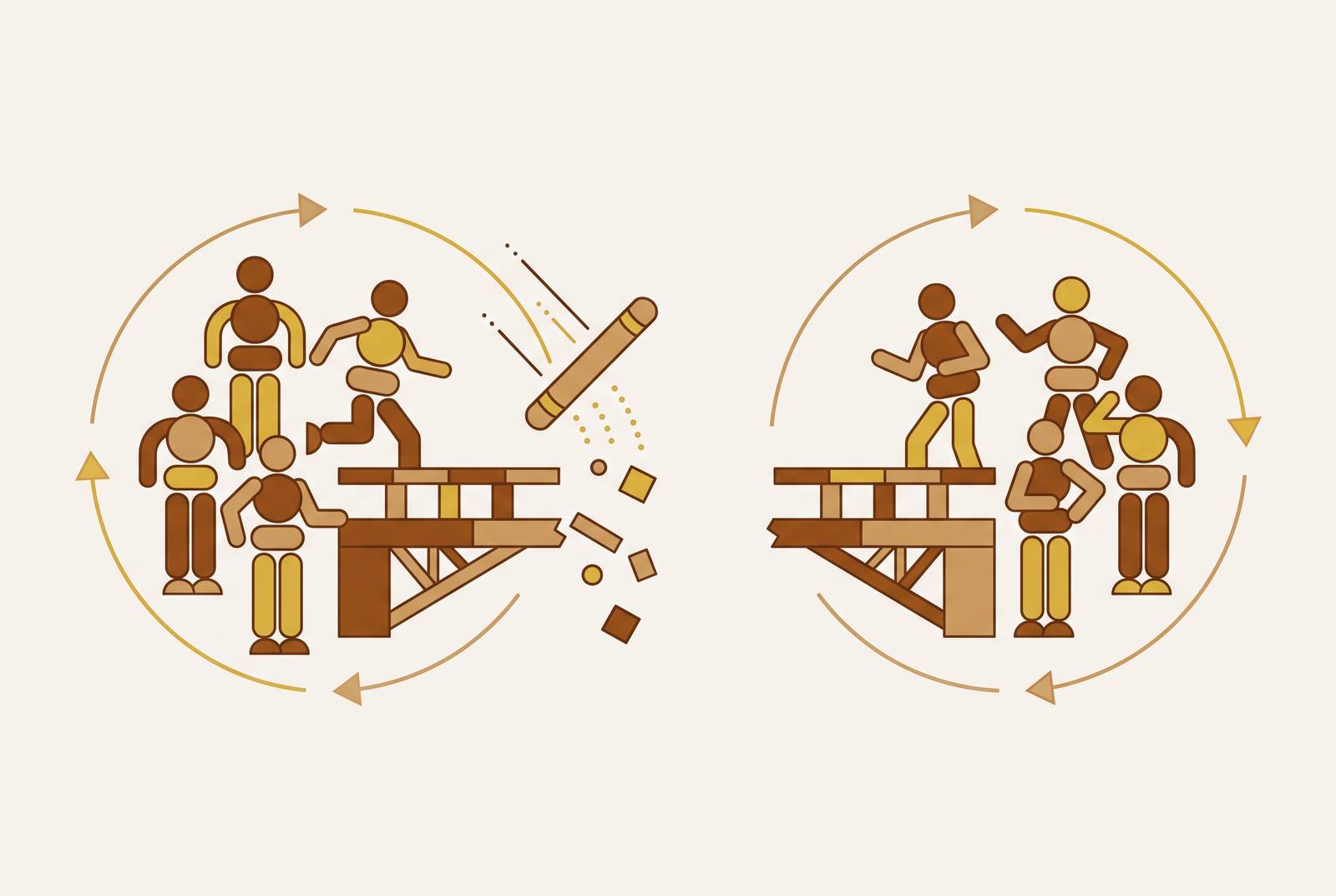
Cross-functional teams lose sprint context because the systems they use were never built to hold it. A ticket tracker records a status. A document holds a spec. Neither one records why someone made a choice on a Thursday afternoon. By Monday, that reason is gone.
Why sprint context disappears before the next sprint starts
Context and documentation are not the same thing. A changelog tells you what happened. It does not tell you why the login flow got rewritten instead of patched. It does not tell you which stakeholder flagged a legal risk that ruled out the simpler fix. That reasoning is context. Specs and changelogs were never built to hold it.
This is not a memory problem or a discipline problem. The numbers back that up. 40% of developers say trouble finding context is their biggest productivity problem. 26% of engineering managers say gathering context is their single biggest weekly drain (Cortex 2024 State of Developer Productivity).
How the cost of re-explaining things grows with every sprint
More than 60% of working time goes to communication and coordination. That time is spent on coordination rather than the actual work those meetings are meant to support. The average knowledge worker absorbs 275 interruptions a day Sprint Planning Challenges and Best Practices for 2026 | Easy Agile. Nearly 75% of cross-functional teams fall short on at least three of five delivery measures. Yet 83% of organizations keep using cross-functional structures anyway. Everyone adopts the model. Most teams do not get the results the model promises.
The cost grows because it is invisible at the scale of a single sprint. But it never actually resets. Every Monday spent rebuilding what was decided adds friction. Every decision re-explained adds friction. Every dependency re-confirmed adds friction. None of that shows up on a progress chart. Over time, planning meetings start producing commitments nobody quite believes in.
Rebuilding context eats into your team's real capacity. Estimates become guesses. Dependencies go unspoken because no one had the bandwidth to raise them. The plan that comes out the other end is a compromise between tired people. It is not a shared understanding of the work. 84% of marketers report high friction from cross-functional work. Teams with high friction are 37% less likely to hit revenue goals and 15 times more likely to experience burnout (Gartner).
The four places where sprint context falls through the gaps
In workshops, the most common obstacle to getting value from agile (a way of working in short cycles with regular check-ins) is that teams are not truly cross-functional in practice. That is true whatever the org chart says.
The first gap is too many tools. The average team uses 8 to 12 different tools for communication and project tracking. A decision made in one team's chat thread simply never reaches another team's project board. Context does not cross that boundary on its own. Someone has to carry it over by hand. In most teams, no one has been given that job.
The second gap is missing governance. Governance means having a clear answer to who decides, who gets consulted, and who just needs to be told. Teams with strong governance succeed 76% of the time. Teams without it succeed just 19% of the time. That is a fourfold gap from one factor. Without that clarity, every planning session relitigates questions that were supposedly settled weeks ago.
The third gap is that meetings carry no reasoning forward. Retrospectives (end-of-sprint reviews of what went well and what did not) and planning meetings are good at surfacing what went wrong. They rarely record the reasoning behind a decision in a way the next sprint can use. Once a meeting turns into a status report, the logic behind last sprint's choices stays in that room and expires there.
The fourth gap is dependencies between teams that never get stated out loud. When teams are not truly cross-functional in practice, mapping who depends on whom ends up replacing the more important job of deciding what is most valuable to do next. Feedback takes longer. Wrong assumptions quietly survive two or three sprints before anyone catches them.
The same thread connects all four gaps: none of this is a behavior problem. It is a design problem in the systems teams rely on to carry decisions forward. A 2025 review of research by Tobisch and Matthes backs this up directly. They found that agile practices built for a single team are not enough for coordination and knowledge sharing once an organization scales into multi-team projects.
Why estimates keep being wrong — and what actually causes it
Teams over-commit constantly. A 90% confidence interval on a sprint estimate (meaning the team is 90% sure it will finish) only holds up 60 to 70% of the time in practice. Work tends to run about 30% longer than estimated. The usual response is to treat this as a technique problem: more story points, another refinement session, a round of planning poker (a group exercise where team members estimate effort by holding up numbered cards at the same time). None of that touches the actual cause.
The real cause is simpler. Estimation in most teams is a solo guess made against a ticket title like "Update API." There is no shared check against the hidden changes inside it. There is no check against the database migration it quietly depends on. There is no check against the other team's uncertain schedule that the whole thing is riding on. Nobody is being lazy. Nobody has the full picture in front of them. So they estimate against the title instead of the work.
Fix the missing-context problem and the estimation problem often fixes itself. One Series B SaaS company (a software business at a mid-stage of funding) cited in the research saw sprint predictability jump from 60% to 89% accuracy once the mental load from missing context was addressed. No new estimation method was required Sprint Planning Challenges and Best Practices for 2026 | Easy Agile. That is the difference between a roadmap stakeholders can plan around and one they quietly discount.
Priority frameworks fail under the same pressure. MoSCoW, WSJF, and RICE are scoring systems for deciding which work matters most. They work fine on a short list inside a small group. Stretch the backlog across functions and scoring turns inconsistent fast. "Everything is top priority" becomes the team's actual strategy — which means it has none. If missing context is the root cause, a better meeting was never going to fix it. The fix has to be making context durable enough to survive the gap between one sprint and the next.
What it takes to keep context alive across sprint boundaries
Context that survives a sprint boundary needs three things present at once.
First, decisions need to be recorded with the reasoning attached. "We chose X" tells the next sprint nothing useful. "We chose X because constraint Y ruled out Z, which the legal team flagged on a specific date" tells them everything they need to not reopen the debate.
Second, that record has to live somewhere the next sprint's participants can actually find it. No one should need to rebuild a conversation from memory. No one should have to search through a chat history that half the team never saw.
Third, dependencies — both technical and organizational — need to be written down. They need to be attached to the work they affect. They should not live only in the head of the one person who remembers them.
A peer-reviewed study by Carvalho and Choo, published in the International Journal of Managing Projects in Business, identifies exactly this tension. Structured knowledge management and agile's short-cycle rhythm pull against each other. Without a plan for managing knowledge, the result is rework, quietly disappearing information, and almost no learning shared between projects that should be learning from each other.
Shared goals do the anchoring work. When sales, legal, and engineering are all pointed at the same outcome, a sprint decision can be checked against that common goal. It does not need to be reopened from scratch every cycle. Someone also has to own keeping context current. Teams that treat it as everyone's job end up with no one doing it. What cross-functional teams actually need is one converging layer — not necessarily one tool, but one place. Updates, decisions, and dependencies should be visible there to anyone who touches the work.
How connecting information across separate systems changes sprint decisions
The context that matters for a sprint decision almost never sits in one system. Take a hiring pipeline as an example. A candidate's licensing progress, support history, and onboarding status might each live in a completely different system. Planning around that person means connecting what those three records mean together.
The same pattern appears in ordinary sprint decisions. A feature estimate might depend on another team's capacity sitting in one tracker. A legal constraint might be written into a policy document. A dependency on an outside service might be buried in a ticket. A stakeholder's priority call might exist only in a meeting note. Those four pieces sit in four separate places. They wait for someone to notice the relationship between them — usually too late.
When structured data (business records) and unstructured data (documents, conversations, past decisions) are brought together in the context of the work, AI tools can surface what a planning team would otherwise rebuild manually each sprint. The value is not in showing raw data from each system side by side. It is in connecting the meaning and the relationships across those systems. That way, a recommendation can be checked against the full picture instead of a fragment of it. A recommendation that shows its evidence and its assumptions lets a team agree with it or correct it on the spot. That is a very different experience from staring at a dashboard that shows numbers without explaining what those numbers mean for the decision in front of you.
One discipline matters here and is easy to skip. Keep estimates that come from connected context separate from measured, observed results. Time-saved projections should not be blended with actual cash savings. Better inputs make estimates more accurate. Whether it actually worked still has to be confirmed against results measured against an agreed baseline — not assumed from better inputs alone.
Governance structures that let context accumulate rather than expire
Context without governance turns into noise. A running record of every decision, every reason, and every dependency becomes unusable fast. You need a structure for what counts as the official record. You need to know who is allowed to change it. You need to know how exceptions get handled when they occur.
Decision records need to connect evidence, recommendations, human reasoning, approvals, and measured outcomes — including the ones that failed or came back inconclusive. Corrections and explanations added later are part of that record too. They are not a footnote on the side. The authority structure for context needs to mirror the authority structure for the decisions themselves. Reading a record and changing a record are two separate permissions. Someone approves within limits they set in advance. Exception owners get named before something breaks, not after.
For AI-assisted context systems, audit trails need enough detail to rebuild the full sequence of steps in any given workflow. That logging requirement has to be set at the start. Do not add it after someone asks a question the system cannot answer. Past sprint context also has an expiration condition: it is only valid as long as the conditions that produced it still hold. Any system reusing a past lesson needs to check whether the situation has changed before applying it again.
Human judgment still has to sit at the center of the harder calls. 72% of consumers prefer working with a person for complex decisions (2025 Deloitte study). The practical implication for governance design is that AI-assisted context systems handle standardized, data-rich retrieval. A person remains the decision point on complex or high-stakes calls. And whatever gets built — the decision history, the outcome record — needs to stay with the team that built it. It should not be locked inside a vendor's environment where nobody can audit it or carry it forward if the platform changes.
How cross-functional teams keep context alive at sprint boundaries
Teams that actually solve this do not try to fix everything at once. They start with one named workflow, one accountable owner, and one measurable outcome. They agree on the baseline and the success measures before the first sprint starts. That gives context something concrete to build toward instead of floating free.
They bring together the decision layer without forcing every function onto the same tool. Design keeps its design tools. Engineering keeps its tracker. But the place where decisions get recorded, dependencies get flagged, and reasoning gets captured is one shared layer. Every function can read it, regardless of what tool they use day to day.
They also stop treating retrospectives as the whole solution. A retrospective identifies what went wrong, which is useful. But it was never built to transfer context forward. A separate, short practice at the close of each sprint does the actual handoff work. It captures the decisions made, the assumptions that held up, and the dependencies that shifted. The goal is a record the next sprint's participants can read cold — without needing anyone to rebuild the conversation for them out loud.
Dependencies get mapped before planning starts, not discovered mid-sprint as a surprise. Folding dependency mapping into backlog refinement (the regular process of reviewing and preparing upcoming work items) turns the most common sprint killer — the undisclosed external dependency — into something visible early enough to plan around.
The real measure is sprint predictability. If commitments hold sprint over sprint, context is doing its job. If your team is still relitigating last month's decisions in this month's planning meeting, the structural gap never closed.
For enterprise teams bringing AI-assisted context systems into this picture, the order of steps matters as much as the tool choice. Start with investigation and recommendations only. Let the system take actions only after quality and value have been shown over time — not on day one. Separate read access from write permissions from the very start. That way, governance scales alongside adoption instead of being added after something goes wrong.
Sources
- Sprint Planning Challenges and Best Practices for 2026 | Easy Agile
- Cross-Functional Collaboration: Why Most Teams Fail and How to Fix It (2026)
- Workplace Collaboration Statistics 2026: Tool Fragmentation, Cross-Team Friction, and Coordination Costs
- Understanding how agile teams reach effectiveness: A systematic literature review to take stock and look forward - ScienceDirect
- Agile Estimation Challenges: How to Improve Software Team Alignment in 2026 | Easy Agile
- Durable teams: more than a series of sprints - Global Integration