How to Measure Institutional Memory Depth in Your Organization
Measure institutional memory by whether reasoning behind decisions survives personnel changes.

Most organizations mistake storing information for remembering it. The real test of institutional memory is whether the reasoning behind past decisions is still there when someone needs it.
A new general manager walks in on day one. They inherit a binder full of policies, a dashboard full of metrics, and a drive full of documents. What they almost never inherit is the reasoning behind any of it. Why did the pricing exception get approved last March? Why does the vendor contract leave out a clause every competitor includes? Why did the team try the obvious fix two years ago and quietly drop it? The binder survives. The judgment that built it leaves with the person who made it. That gap, not the thickness of the binder, is the real measure of how much institutional memory your organization actually has.
Most companies measure the wrong thing. They count documents. They count systems. They ask whether knowledge management software is used across departments, whether the wiki has enough pages, whether the CRM logs every customer interaction. None of that tells you whether the company remembers anything that matters. A company can run an active knowledge management program, fill shared drives for a decade, and still lose critical expertise the day three senior people take new jobs. Records tell you what happened. They do not tell you why it worked, why it failed, or what to do differently next time. That second set of answers is the only part with real value. A policy without its reasoning is a rule nobody can safely bend, extend, or retire. That is because nobody left in the building understands the conditions that created it.
The four things enterprise memory needs to preserve
Institutional memory is not one thing to protect. It splits into four layers. Each one fails in its own way. Each one needs its own approach to stay intact.
Decision memory holds the choice itself. It records who owned it, what evidence they weighed, what they assumed, and what outcome they expected. Without this, every recurring decision starts from zero, even when your company has made a nearly identical call a dozen times before. Think of it as a connected record. It ties decisions to their evidence, their limits, their reasoning, and their eventual outcomes. That way, you can use it as a reference the next time a similar situation comes up. The incoming general manager is missing exactly this. The policy binder tells them what the price floor is. It says nothing about whether last year's concession actually saved the account.
Process memory covers how work actually gets done. It includes the failure points and workarounds that never make it into a formal manual. The official procedure, written for an audit, describes an ideal version of the job. The real version, with the extra step someone added after a near miss, lives somewhere else, or nowhere. Process records keep their value only when they stay tied to the specific workflows and systems they describe. A process document cut loose from the system it covers goes out of date fast.
Exception memory tracks unusual cases. These are the ones where policy and reality pulled apart. One exception might be a one-off. Five exceptions to the same rule usually mean the rule needs redesigning, not more enforcement. Exception cases need to be stored alongside the standard procedures they changed. When you treat them as isolated incidents, they disappear from your organization's ability to learn from its own history.
Relationship memory holds commitments, sensitivities, and the history built up with specific people and partners. It carries real business value. It is also sensitive, so you need to think carefully about who can see it and when. When someone leaves the company, it tends to disappear. So much of it never gets written down anywhere.
What "depth" actually means for each layer
Depth has nothing to do with how much is stored. It is about whether you can trace the reasoning, the authority behind it, and the outcome it produced, layer by layer.
For decision memory, depth means being able to reconstruct who owned a decision. It means knowing what evidence they had, what options they turned down, and whether the result matched what they expected. A record that only states what was decided, with none of that surrounding context, is shallow, no matter how official it looks. Research on hiring decisions shows what the deeper version looks like in practice. You trace a decision from the input that triggered it through to its outcome, tied together with a shared identifier. That builds a record of institutional knowledge you can actually search later. That is what depth gives you. A trace like that gets used. A record that only states an outcome just gets filed.
For process memory, depth is measured by the gap between the documented steps and how the work actually happens. A process description with no record of its exceptions or workarounds is shallow, no matter how polished the official document looks.
For exception memory, depth means knowing not just that an exception happened, but what it revealed about the policy that did not quite fit. A log that lists exceptions without tracking what came of them is just a list. It is not something your organization can learn from.
For relationship memory, depth means whether the reasoning behind a commitment, a concession, or an accommodation is there for whoever takes over that relationship next. Without that reasoning attached, the relationship does not transfer. It resets. The new person spends months rebuilding trust and context that already existed once.
The same rule holds across all four layers: document the decision with its reasoning, not just its outcome. Depth simply means whether that reasoning is actually there.
The three ways reasoning goes missing
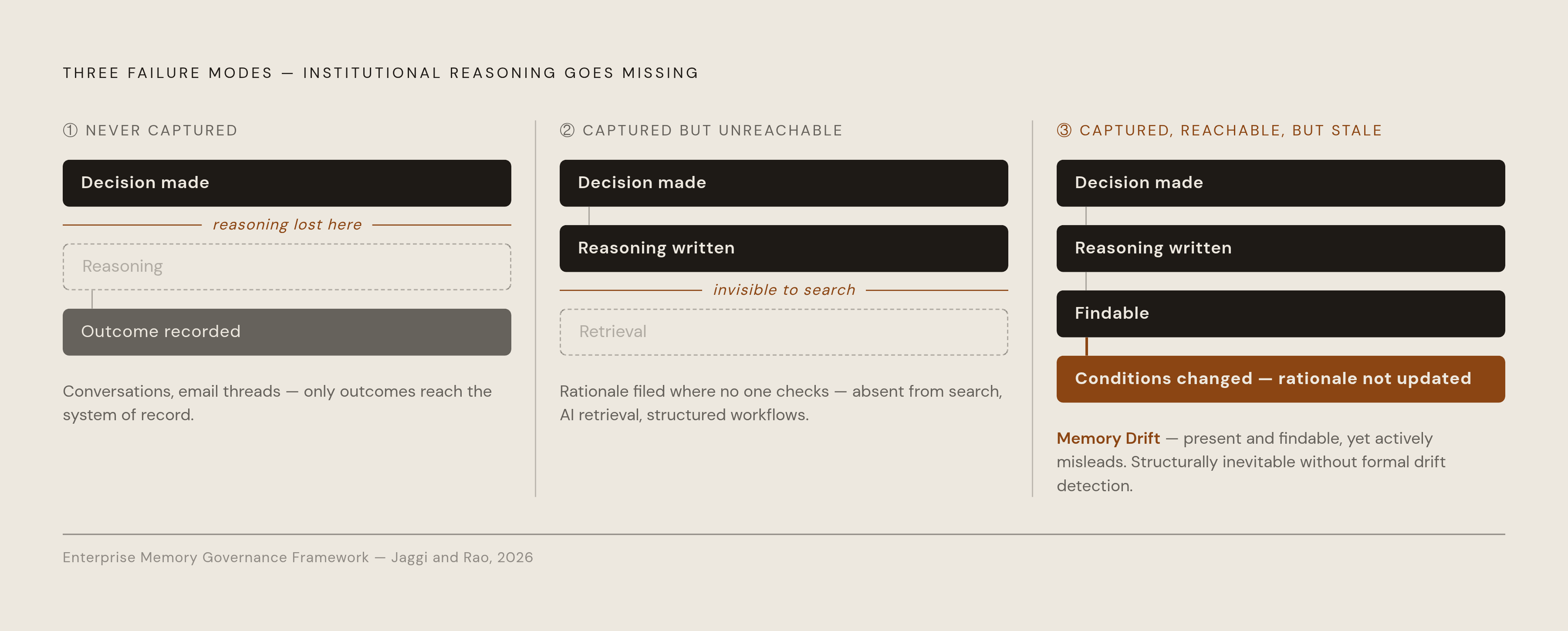
Reasoning disappears from organizational memory in three distinct ways. Each one needs its own way of being detected.
The first is reasoning that was never written down at all. Decisions get made in conversations, email threads, and hallway exchanges. Only the final outcome ever makes it into a system of record. The reasons live in email threads, deal-desk calls, and hallway conversations, and nowhere else. The record of what happened exists. The reasoning behind it was never written down. You can spot this by comparing how many decisions show up in a system of record against how many come with any traceable reasoning attached. A wide gap between those two numbers points straight at this problem.
The second is reasoning that exists but cannot be found. The reasoning got documented somewhere. But it sits in a system, a format, or a location nobody thinks to check when they actually need it. Stored knowledge only has value if it comes up reliably through search, AI tools, or structured workflows built for that purpose. When it is not reachable that way, depth exists on paper and nowhere else. You can test for this directly. Can a new employee, or an AI agent working on your behalf, find the reasoning behind an active policy without having to track down a human who remembers it?
The third is reasoning that was captured and can be found, but has gone out of date. Conditions changed, and nobody updated the reasoning to match. It now describes a world that no longer exists. The Enterprise Memory Governance Framework, published by Jaggi and Rao in 2026, is among the first enterprise memory structures to include a formal method for detecting and measuring this kind of drift. That confirms the problem is structural, not just a matter of someone forgetting to save a file. The signal to watch is the date a piece of reasoning was last checked, measured against how fast the underlying area actually changes. A policy built on reasoning from three years ago, sitting inside a regulatory environment that shifts every few months, is a stale memory risk, whether or not anyone has noticed yet.
A simple framework for assessing institutional memory depth
Three questions, applied to each of the four memory layers, turn this from a vague worry into something you can actually measure. Is the reasoning present? Can it be reached? Is it current? Running those three questions across decision memory, process memory, exception memory, and relationship memory produces a map. It shows you which parts of your organization's memory are solid, and which parts are one departure away from disappearing.
Presence is the first question. The most useful measures connect completeness and use to real business continuity, not to how many records exist. A practical test: pull a sample of important decisions from the past two or three years. Try to reconstruct the reasoning behind each one using only organizational records, without calling the people who made them. Whatever you cannot reconstruct that way shows you exactly where presence is missing.
Retrievability is the second question. For each layer, can someone who was not in the room still find the reasoning behind a decision, using the systems your company runs today? Stored knowledge only counts as retrievable if it comes up through search, AI tools, or structured workflows. You can measure the absence of this. Test whether a new hire or an AI agent can surface prior reasoning without escalating to a person. The Enterprise Memory Governance Framework also introduces something called the Recall Boundary. This is an access control function that governs which agents, which people, and which contexts are allowed to retrieve which memory records. An organization with no version of this cannot confirm whether its retrievability is managed or simply accidental.
Currency is the third question. For each layer, has the documented reasoning been checked against current conditions recently? Does that checking happen often enough to match how fast the area changes? The Memory Drift construct from the governance framework gives this a formal basis. It measures the share of stored memory records that have moved away from their original source of truth at a given point in time. An organization that cannot answer this question for its most critical memory has no early warning system for reasoning that has quietly gone wrong. The Memory Provenance Chain, the traceable sequence showing how a piece of information moved from its original source through every change up to its current state, is what makes this possible. That chain is needed both for checking currency and for meeting data erasure rules under data protection law. Without it, neither is something you can reliably do.
Putting this into practice does not mean replacing your existing systems. Start with one named workflow. Assign someone who is accountable for the assessment. Agree on a measurable outcome before you try to scale further. The framework's job is to connect what existing systems already know about a given workflow. Nodes is one example of a system built around this approach. It connects to a company's existing systems, builds a connected map of company records across relationships, provenance, decisions, and outcomes, and uses decision records to link evidence, signals, models, policies, recommendations, human input, execution, and measured outcomes, including the ones that failed or came back inconclusive. Nothing happens without a person's approval. The reasoning stays available as a reference for the next decision, instead of living only in the memory of whoever made the call.
AI tools make memory depth urgent, not optional
An AI agent working off shallow or out-of-date institutional memory does not just give a weaker answer than it should. It takes action. The errors from that action can spread across connected systems faster and wider than a single person's mistake ever would. The governance framework's Stale Memory Amplification Property describes this effect. Past a certain level of Memory Drift, answers generated using that memory grow less accurate than answers generated with no memory access at all. A memory system that has drifted past its own governance threshold does not sit still. It actively makes AI performance worse.
Access control makes the risk worse still. Enterprise AI memory systems as built today generally do not enforce role-based or attribute-based control over what gets retrieved. Any agent with access to memory can pull any stored record. It does not matter how sensitive the record is, what task the agent is working on, or who originally asked the question. A relationship memory record meant for one account manager can end up feeding a completely unrelated process, with no check in place to stop it.
Regulation is starting to catch up with this risk. Under GDPR, individuals have the right to ask that their personal data be erased. Meeting that request against an AI memory store depends entirely on having a traceable Memory Provenance Chain in place. Without that chain, there is no reliable way to find every place a piece of data touched. That makes it impossible to reliably erase it. What started as a question of operational continuity, how to keep your organization from forgetting its own reasoning, becomes a question of legal exposure the moment that reasoning gets fed into a system that acts on its own.