How to Choose the Right AI Model for Each Job
Match each task to the smallest model that reliably does it.
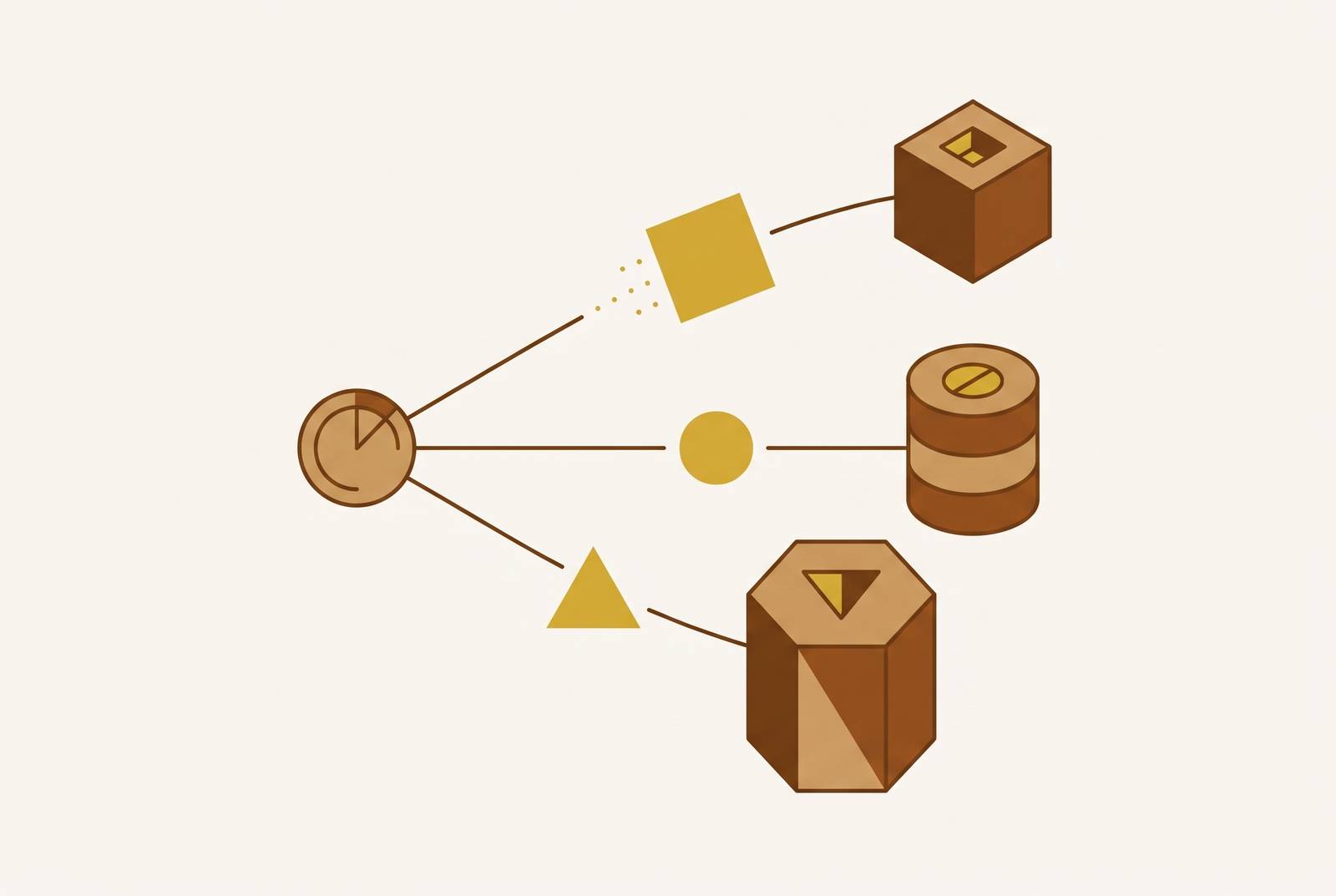
Choosing the right AI model for each job starts with classifying the task. Match each call to its complexity, latency requirement, and quality threshold, then use the smallest model that reliably meets those needs. Buyers of enterprise cost optimization software can evaluate it by whether it connects those decisions to total workflow cost.
Why model selection is the most correctable source of rising AI costs
Prices per token are falling, but enterprise AI bills are going up. Cheaper calls lead to more uses, larger contexts, and more users, so use can grow faster than prices fall. This is the Jevons paradox applied to AI.
The bill also extends beyond the model itself. NavyaAI Research estimates that the model invoice represents a minority of total production AI costs, with the larger share coming from orchestration, retrieval, retries, and observability. Those costs depend on how work moves through the system. A model that seems cheap can therefore be part of a costly workflow, especially when it takes several attempts to finish a task.
The most correctable architectural mistake is the flat model strategy. Teams choose a frontier model early, then keep using it for every call regardless of what the task requires. Routine classification inherits the same cost structure as difficult reasoning. That is like hiring a limousine to travel two blocks. The capability is available, but the expense comes from a default rather than a demonstrated need, making model selection a clearer target than waiting for another price cut.
Why agentic workflows make the flat model strategy expensive at scale
A single-call pilot makes this default look manageable. An agentic workflow changes the calculation because one task can trigger multiple model calls, tool attempts, and reasoning steps. The same premium tier now applies throughout that chain. Cost grows with the number of steps and how much work each step sends to the model, as well as with the number of user requests.
Failed tool calls can make that multiplication worse. Each new attempt adds to the context and creates more inference cycles, and an agent without limits can keep spending before anyone gets a warning. Circuit breakers and task-level spend limits put a cap on that spending. Without them, a model price that looked reasonable in isolation says little about the cost of finishing the job.
Output length adds another source of expense. Output tokens cost more than input tokens on most models, so long summaries and multistep reasoning can accumulate charges even when prompts are carefully trimmed. Optimizing only the input misses part of the mechanism. A flat strategy compounds the problem by paying the same premium rate for routine intermediate work as for the final judgment. The relevant unit of cost is therefore the completed workflow.
The three variables that should drive every model selection decision
Each call needs to be classified by three inputs: task complexity, latency requirement, and quality threshold. Complexity separates structured output, classification, and straightforward summarization from multistep reasoning, code generation, and judgment under ambiguity. The distinction needs honest assessment. A task does not require frontier reasoning merely because it belongs to an important business process.
Latency then changes what counts as a good result. Larger models are generally slower, and a small improvement in output quality may not justify the delay in a time-sensitive workflow. Quality threshold sets the minimum acceptable result. Together, these inputs answer what the task demands, how quickly it must finish, and how reliably it must perform.
A fourth question constrains which choices are available. Can the data leave the enterprise perimeter for a commercial API, or must it stay on-premise with a self-hosted model? Data sensitivity can rule out a model that otherwise fits the task. Volume and frequency then determine the financial priority of the decision, since a small difference at a hundred calls per day becomes substantial at a million. These are live routing inputs.
How to map tasks to model tiers before writing a line of routing code
The three-tier map starts with narrow tasks done over and over. Structured extraction, routine classification, and predictable outputs are candidates for a smaller model, provided it meets the quality threshold. This is the lowest-cost tier in the map. For stable tasks at high volume, it can include a fine-tuned smaller open-source model, though the cost of specialization belongs in the comparison.
The middle tier is for work that needs a more capable model but can be done without frontier-level judgment. Summarization and extraction belong here when tests show that a smaller model falls short but a mid-tier model can do the job. Its cost sits between the smaller and frontier options. The boundary depends on task performance.
The frontier tier is kept for difficult reasoning, demanding code generation, or judgment under ambiguity. Examples named in the source material include GPT-4o, Claude Opus, and Gemini Ultra, but such labels need version context. OpenAI’s release notes place GPT-4o’s retirement from ChatGPT on February 13, 2026. Anthropic’s platform documentation names Claude Opus 5.5 as its flagship, while Google’s release notes identify Gemini 4 Argon and Gemini 4 Carbon as successors to Gemini Ultra.
The cost map is directional. The supplied material gives no comparable per-tier price ranges or named examples for the lower tiers, so attaching dollar figures would imply unsupported precision. In practice, the router acts as a dispatcher, matching the task to the needed service level as models and prices change.
When fine-tuning a smaller model beats routing to a larger one
Routing is not always the final economic step. For a high-volume task with a narrow, stable definition, fine-tuning a smaller open-source model on enterprise data can cost less overall than repeatedly buying general capability from a commercial model. Specialization preserves quality on the particular job rather than trying to match a frontier model across every possible task. Its advantage comes from repetition.
The objection is that fine-tuning costs money and takes effort to maintain. That is a valid objection for changing or low-volume work. The economic test is whether the savings on completed tasks exceed the upfront tuning expense and the ongoing cost of maintaining the specialized model. The number of calls needed to break even depends on those costs.
This narrows the recommendation considerably. Fine-tuning fits tasks that stay the same and run at high volume, as long as the smaller model reliably meets the quality threshold. It is not a general substitute for routing, nor does a cheaper inference rate establish a lower total cost of ownership. If the task keeps changing, maintenance can consume the expected savings. If volume is too low, even a successful specialized model may not earn back the work needed to build it.
What mismatched model selection actually costs in a back-office workflow
Back-office work makes these trade-offs visible because the same tasks recur at high volume. In accounts payable, support ticket triage, and document classification, teams can make the same good model choice or costly mismatch many times. Small per-task differences accumulate. Automation’s financial value depends on lowering the cost of completing acceptable work as it replaces a manual step.
Invoice processing illustrates both sides of the problem. Automation can substantially reduce the fully loaded cost of manual processing, but unnecessary frontier calls on routine extraction erode that advantage. Underpowered models can erode it too if their output requires repeated calls or additional review. Support tickets follow the same pattern, with password resets and status checks offering little reason to purchase complex reasoning when a lower tier reliably handles the intent.
JPMorgan’s COiN system reads commercial loan agreements, extracts around 150 key attributes, and flags issues for human review. That task profile illustrates a potential fit for a fine-tuned or mid-tier model. ServiceNow’s HR shared services deployment also shows how much high-volume work done over and over can save, through its reports of hours saved and costs avoided. Neither example establishes perfect model optimization. Both show why the task itself is a better starting point than the prestige of the model handling it.
The strongest objection is that quality degradation is hard to measure until it matters
The strongest objection to aggressive tiering is legitimate. A query classified as simple may contain ambiguity that the smaller model handles badly, and the failure may remain hidden until it affects a real business outcome. Average performance can make that risk easy to dismiss. Lower spending is not evidence that the routing decision was sound.
An inexpensive model can also cost more overall. Poor answers can trigger retries, extra human review, or inefficient data movement, wiping out the apparent savings on tokens. The quality threshold must therefore spell out how well the task needs to be done, going beyond a vague sense that the answers look good. Classification needs ongoing evaluation because assumptions about which requests are simple can be wrong.
The resolution is to instrument routing from the start. Teams should log outputs, check a sample against the quality threshold for the task, and re-route work when quality drops. That creates a basis for changing tiers when the evidence changes. It does not make underpowered models safe for every task.
Architecture can still block the response. When pipelines and orchestration are tightly coupled to one provider, switching to a better-fit model may require a major engineering overhaul. Teams therefore need both quality measurement and an architecture that lets them replace models, so they can act on what an audit finds.
How do enterprises find cost savings through governance and visibility?
Provider dashboards show account-level spend, but that view does not explain which team, application, feature, or agent created the expense. Execution-level tagging supplies the missing attribution. Without it, finance cannot link spending to business goals, while engineering has trouble finding the costly workflows. Enterprise cost optimization software should bring those views together so each team can see more than its own part of the bill.
Cox Business illustrates the breadth of visibility required. Eric Pace, its Head of AI, stated that the company achieved visibility across SaaS-based modules, new purchases, and enterprise token consumption, while emphasizing that it required intentional architecture and governance from the start. The scope extends beyond API invoices. It includes the places where AI is purchased inside other software and the workflows that consume it.
That visibility needs controls that still work as usage grows. Slow adoption of better models, deep provider coupling, and agent workflows without circuit breakers are warning signs that the architecture is falling behind. When models can be replaced, workloads can move to a model that fits without teams having to rebuild the system around it. Continued monitoring then accounts for changing usage, new workflows, and new model options instead of assuming the original tier map will remain economical.
A useful tool connects spending to the task, the result, and the person responsible for the decision, so duplicate calls or overpriced tiers can be assessed in business terms. Nodes Engine is one option that connects data across systems and records each decision with its proof, approval, action, and result, helping teams see which model choices and workflows drive expense. It routes findings to the people responsible, with no change made until a person approves it.
Maintaining visibility and routing discipline over time turns a one-time cost cut into a durable cost architecture.