Why AI Agent Controls Should Be Built In, Not Added Later
Agent controls added after launch can't check actions already taken.

Enterprise cost optimization software that uses AI agents needs controls built into the way those agents read data, get approval, and record what they do. Agents act across systems in milliseconds, so controls added after deployment cannot check actions that have already happened. The strongest basis for evaluating a platform is not how freely its agents can act, but whether it can make their access, decisions, and costs visible from the start.
Why governance frameworks designed for human workflows cannot keep up with agents
Enterprise governance was built around a human being as the last step before something changed in a real system. A person could review a request, question its purpose, or stop it before execution. Production agents remove that assumed pause from the workflow. They call tools, access data, and trigger downstream systems in milliseconds, far faster than a weekly review or an email that signs off on a policy.
Approved-model lists, platform policies, and architecture review boards still have a role. They establish which tools an organization permits and which uses it has considered. But approval is not the same as enforcement. Island's 2026 governance analysis shows that platform-layer controls can see what an agent was configured to do without seeing what it actually did inside a user's tab, terminal, or desktop application. A policy can be sound while its enforcement stops short of the place where the agent works.
What agents actually do that makes after-the-fact controls structurally blind
An agent working inside an employee session inherits whatever that session can reach. Its access therefore extends beyond the narrower needs of its task. Accountability blurs at the same point. When an agent borrows a logged-in session or a shared service account, the audit log records one identity doing twice the work. A security operations team cannot reliably separate the person's actions from the agent's actions using that identity alone.
Repurposing an agent makes it harder to see when its permissions exceed the needs of its task. Permissions granted for one use case can follow it into another without review for the new context. BCG's 2026 control plane guide identifies this as a consequence of platform-by-platform governance, with sensitive data moving to external models without safeguards and agents reaching systems they were never meant to access. The original permission may have been entirely reasonable. What is missing is a decision about whether it still fits the agent's current task.
CISA and Five Eyes partners' joint guidance, Careful Adoption of Agentic AI Services, published May 1, 2026, advises against broad or unrestricted agent access to sensitive data or critical systems. It calls for continuous runtime authentication, with centralized policy decision points evaluating each action. Reviews done from time to time cannot check each action in the same way. NIST's National Cybersecurity Center of Excellence also published a concept paper in February 2026 on applying identity standards to software agents. Together, these efforts put agent identity and live authorization at the center of the problem.
The financial cost of discovering control gaps after agents are in production
Retrofitting governance is not a deferred purchase of the same controls at the same cost. After a production incident, the organization must buy or build the missing controls at emergency-procurement speed while also paying for the incident that exposed the gap. The implementation work has not gone away. It now includes remediation and rework on a running agent estate, potentially while a regulator examines the failure.
BCG's guide documents another source of expense in fragmented governance. Separate platform controls create duplication, raise cyber risk, and complicate cost control as agents spread. Each platform may have rules, but the enterprise still cannot see all its agents, what they can access, and what they cost. More controls do not automatically produce better coverage. For a company trying to find savings across a large business, that fragmentation weakens the very visibility needed to judge whether agents are reducing costs or adding expense that is hard to track.
What controls actually need to be designed in from the start, and where they live
An agent needs its own non-human identity, with an owner, a stated purpose, and a lifecycle. That identity lets the audit record distinguish an agent's action from a person's action at the event level. Access then needs to fit the task. Island recommends just-in-time credentials scoped to a single task and expiring with it. These choices belong in the agent's design because they define how it reaches systems whenever it runs.
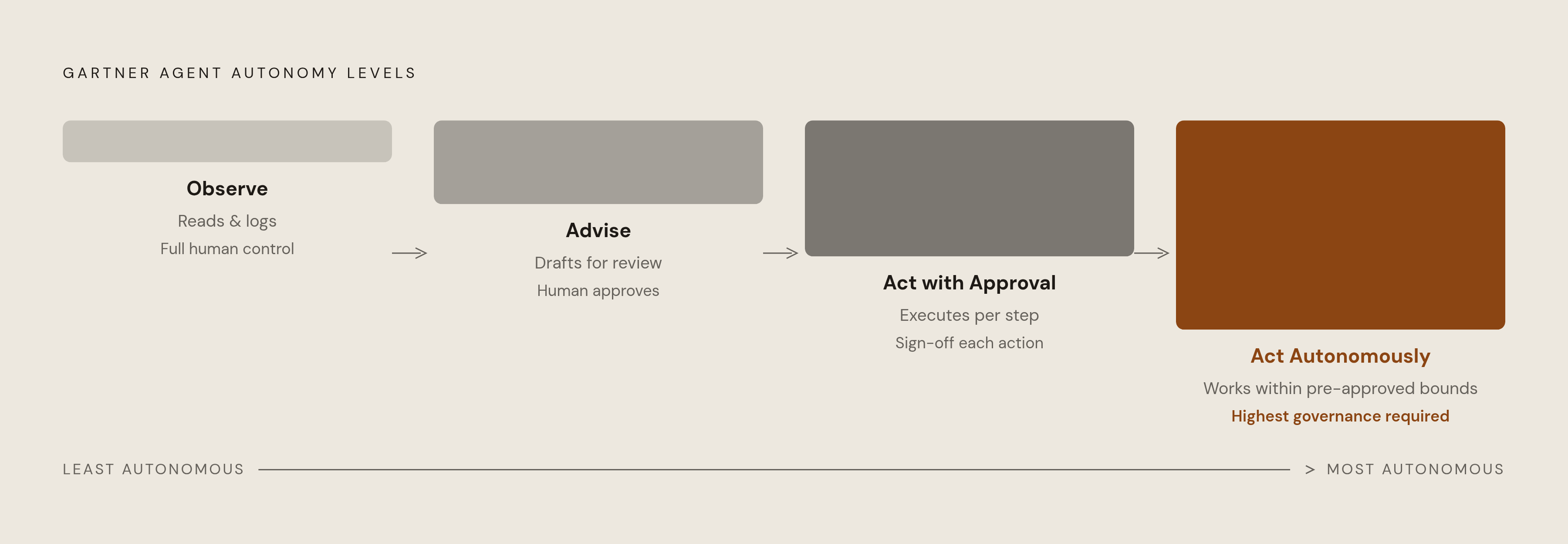
Gartner's May 2026 analysis describes four autonomy levels that make the next design decision concrete. Observe means the agent reads and logs only, while Advise means it drafts work for human review. Act with approval allows execution after human sign-off on each state-changing step. Act autonomously permits work within pre-approved bounds. The appropriate level depends on scope and consequence.
Those levels become useful only when the workflow enforces them. Governance as code can limit permissions, allow access only to approved datasets, block sensitive data, and set limits based on the environment. It can also route high-impact or exception actions to a person before execution. The approval must precede the change it governs. These controls implement decisions about ownership, scope, and acceptable autonomy, but they do not replace the need to make those decisions.
The action record belongs in that same execution path from the first deployment. A full trace captures the evidence, the reasoning, the approval, the action, and the result, including failed actions. Automated, time-stamped records give the organization a sequence it can examine. Failed attempts belong in the record too. A trace added later cannot show what happened before recording began.
Why a central control plane beats platform-by-platform governance at scale
Platform-level controls are still needed to enforce rules where agents work. But those controls are not sufficient when agents spread across dozens of platforms that do not share data. Each platform sees only part of the estate. BCG identifies four shared capabilities for a central control plane, namely central identity, an agent-and-tool registry, real-time policy enforcement, and deployment templates. With this common layer, teams can use platforms that suit their work and share the same rules for enterprise governance.
The registry determines how much of that estate the organization can actually govern. An agent missing from the inventory is also missing from the common control layer's view. Island notes that a useful inventory extends beyond formally provisioned enterprise agents to what runs on endpoints, including MCP servers, skills, and AI extensions. Formal procurement is not the boundary of agent use. Microsoft's August 2026 Agent 365 post describes this wider task as governing an enterprise AI workforce, with rules for agent-specific identity, policy, and audit that cover the whole workforce.
Central governance does not have to make teams wait longer to deploy. BCG's golden path model uses pre-governed, production-ready templates through which builders inherit identity, registration, monitoring, and policy enforcement controls. That changes governance from a separate hurdle into part of the normal build path. Adoption is still essential, because a central layer that platform teams do not use leaves the underlying fragmentation intact.
The governance trap that derails well-intentioned programs is treating all agents the same
Gartner analyst Shiva Varma describes the binary trap as treating agents as “either locked down or fully trusted, and that is the root cause of failure.” Uniform restrictions can burden low-risk work while giving high-risk agents no more scrutiny than read-only ones. Teams then have a reason to route around the controls. Gartner predicts that 40% of enterprises will demote or decommission autonomous AI agents by 2027 because of governance gaps identified only after production incidents.
An agent that reads data and logs activity warrants different treatment from one that executes financial transactions without approval. Their ability to change the business is different. A low-risk, read-only agent can follow a lightweight path, while a high-consequence, state-changing agent gets the full approval chain.
What organizations that got this right did differently from the start
Cox Business Head of AI Eric Pace describes how the business sees all its AI spend, including SaaS-based modules, new purchases, and token consumption across the enterprise. He attributes that visibility to intentional architecture and governance from the start. The timing is the important distinction here. Spend visibility was a requirement of the system being built.
LaunchDarkly CIO Rhonda Baldwin reports that coding agents and service desk agents helped the SaaS provider cut IT costs and avoid substantial spending. Those results held because agent scope was defined and bounded at build time. Cox Business shows the value of making spend visible, while LaunchDarkly shows cost reduction within defined agent scope.
BCG's account of a global biopharma company's 12-month implementation adds the organizational requirement. An empowered enterprise owner, embedded workflows, and platform-team engagement were essential to making the control plane work. Architecture alone was not enough to secure adoption. The guide also finds that governance built in from the start cuts governed setup time dramatically compared with retrofitting controls onto a running estate.
How do you evaluate whether an AI agent platform has governance built in or bolted on?
Finance, operations, or technology leaders can use four tests to check claims about governance in enterprise cost optimization software. They concern identity, policy enforcement, audit records, and escalation. The evaluation needs to establish how the platform assigns authority, where it checks that authority, what it records, and when a person must intervene. A platform that cannot explain those choices at the design level is relying on controls added after the fact.
The first test asks whether each agent has its own non-human identity, owner, and lifecycle. Island proposes a practical check using a single action from a SaaS audit log. The security operations team should be able to identify confidently whether a person or an agent performed it. The related policy test asks whether enforcement evaluates actions where the agent works.
The audit test asks whether records capture evidence, reasoning, approval or denial, action, and result, including failed and denied actions. A successful-action log is not a full trace. The escalation test then asks whether human-review triggers were defined in the workflow at build time and matched to consequence and autonomy level. Platforms connecting HR, finance, sales, support, and operations demonstrate these principles when they keep read permission separate from change permission and require a person's approval before state-changing execution.
These tests also have a regulatory dimension. The EU AI Act's August 2026 transparency provisions under Article 50, with record-keeping under Article 12 delayed to December 2027, and its forthcoming high-risk obligations raise the stakes of incomplete answers. Operational visibility and regulatory readiness are connected, but they are not interchangeable. The buying decision should establish whether controls are part of the agent's execution path today, rather than accept a promise to add them after the first failure.