How to Switch AI Models Without Losing What Your Company Knows
Keep company knowledge separate from the AI model serving it.
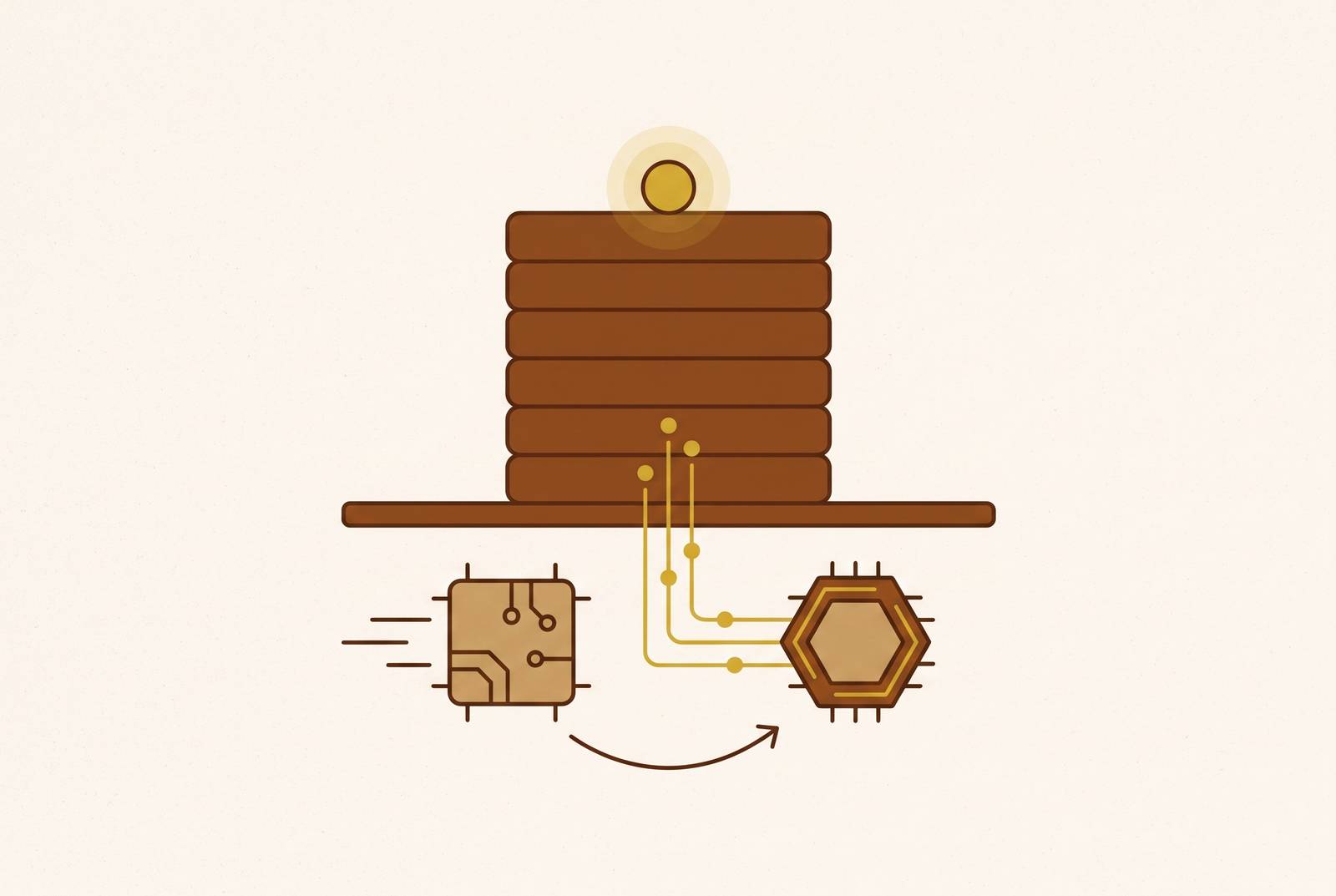
To switch AI models without losing company knowledge, a company needs to keep context, decision history, and business rules outside the model itself. The replacement may match the old model’s capabilities quickly, but it cannot recover approvals, corrections, and exceptions that were never stored independently.
Why companies switch AI models more often than they planned
A contract renewal, a cheaper specialist model, or a new compliance requirement can reopen a model decision that seemed settled. The original choice need not have been wrong. As enterprises build dependencies across several vendors, switching becomes recurring operational work.
The difficulty usually appears after the decision to switch. Teams then discover how much of the application depends on the old model’s behavior, memory, and surrounding tools. A replacement may meet the requirements for buying it and still leave teams with much more work to do. That gap is where the company’s accumulated knowledge becomes exposed.
What actually gets lost when a model changes
A replacement model may handle the same task but lack the record of which outputs the company accepted, which actions needed approval, and which exceptions prompted corrections. Retuning can improve its answers. Retuning cannot bring back a history that nobody kept.
Workflow calibration is one source of loss. Prompts, system instructions, and evaluation benchmarks tuned to one model do not transfer cleanly to another model’s reasoning patterns or failure modes. Vendor-specific fine-tunes create a different problem because their trained weights cannot be ported out of the vendor’s infrastructure. The fine-tune becomes a sunk cost.
Approval and decision history is harder to replace. It records what the AI was authorized to do, what it actually did, and what people approved or corrected. Teams also develop unwritten expectations about a model’s behavior, creating a dependency that is cognitive as well as technical.
Why the standard approach to AI memory makes this worse
Common ways of storing company knowledge tie it to the system that serves it. Vendor-managed fine-tunes, model-specific embeddings, and platform-native memory can all create that dependency. These are understandable implementation choices. The difficulty is that useful knowledge accumulates in forms that are hard to move.
Fine-tuned weights hold company data that a vendor has processed using its own methods and stored in its own format. Embeddings, which represent content for retrieval, introduce another dependency because different embedding models do not produce equivalent representations. Changing the embedding model can therefore require rebuilding the retrieval index. A switch in the serving model is not automatically a switch in every supporting component.
Agentic workflows deepen the problem through repeated model calls. Session-bound reasoning and decisions across those calls disappear when the session ends. More usage then means more implicit dependency. Switching ends up costing more than the original budget allowed for.
The architectural principle that makes switching practical is separating company knowledge from the model that serves it
Retrieval-augmented generation, or RAG, gives a model information from a separate knowledge store that helps it answer a request. A model-agnostic abstraction layer is an interface that lets an application change its underlying model without rewriting the application. Together, these separate what the company knows from the model used to work with it. The company still needs a knowledge store that it governs.
With RAG, a company can update its data when its knowledge changes, without retraining the model. Proprietary information supplied through retrieval stays outside the model’s weights, so the company keeps control of the knowledge store. Approval records, corrections, and workflow logic also need to be kept outside the model. They should be stored in formats a qualified replacement model can read and use.
There is a real trade-off for narrow tasks. A fine-tuned model can be faster and cheaper when the task is stable and tightly defined. But the calculation changes when the domain evolves, compliance requirements shift, or the vendor changes pricing. The relevant comparison includes both the cost of leaving and the cost of running today’s workload.
What the retrieval layer must preserve beyond the documents themselves
The retrieval layer also needs authoritative source references and document versions, so content can be traced back to its original. Access metadata and permission state preserve who may use that content. Without them, moving the words does not move the rules governing their use.
Deletion state and preprocessing configuration belong in the portable store too. They help the index reflect what the company currently endorses. Approval and correction history adds another essential boundary by recording what was accepted, what was rejected, and why. These records must remain readable after the serving model changes.
Some boundaries can be checked automatically. SHACL, or Shapes Constraint Language, can enforce structural and logical consistency in the knowledge layer, giving replacement models a machine-readable set of constraints. That does not remove the need to preserve usable business records and operating access. The practical question for a decision-maker is whether a different model, given this retrieval layer today, would have what it needs to work within the same boundaries and pick up where the old model left off.
How decision traceability keeps institutional learning from evaporating
What would a new model need to read to pick up where the old one left off? An agentic workflow produces approvals, rejections, corrections, and escalations as it runs. If these remain inside a session, the company loses its record of how AI judgment was accepted or changed.
A durable decision record needs the evidence the AI presented, the reasoning it used, and who approved or rejected the action. It also needs the action taken and the result, including failed or corrected results. The record must identify actions as proposed or authorized.
Those records are not instructions to repeat blindly. Lessons drawn from them should be rechecked before reuse because a correction for one model’s failure mode may not suit another model. Over time, the records form the company’s working theory of how AI judgment should fit its business. Preserving that theory makes substitution possible without discarding the experience that made the old system trustworthy.
GraphRAG and hybrid architectures as the next layer of portability
Some knowledge depends more on relationships than on individual documents. Connecting a supplier to a contract, a risk flag, and a remediation decision requires following several links. Standard vector RAG can struggle with that kind of multi-hop reasoning because retrieving relevant passages does not reliably reconstruct the relationships between them. This is where a knowledge graph can help.
A knowledge graph stores entities, relationships, and business logic in a model-independent structure. GraphRAG uses that structure as part of retrieval, preserving connections that a replacement model can work with. Changes can happen at the graph level without retraining the model or rebuilding embeddings for those graph changes. A hybrid architecture can retain document retrieval while adding the relational layer.
The graph still has to be built and maintained. Extracting relationships has real costs, so GraphRAG is not a universal upgrade. Standard vector RAG is adequate and less costly for simple factual lookup from unstructured documents. The stronger case for a graph comes from relationship-intensive queries, compliance traceability, and coordination among multiple agents.
What reversibility actually requires before you commit to a model
Architecture alone does not prove that a company can leave. Before material workloads go into production, reversibility needs to be demonstrated through containment, continuity, substitution, and retirement. Each deals with a different risk and works on a different timeline. Passing one test does not satisfy the others.
Containment means stopping new work at once if the model behaves badly, using controls over dispatch, credentials, and tool access that have been tested. Continuity means keeping the business service running at the lowest acceptable level without the AI, using a degraded mode that teams have practiced. Substitution means moving the approved workload to another model with agreed definitions of how it should behave, state it can use, and everything ready to run. Retirement means reconciling the work, keeping the evidence that is required, and removing execution paths and active access.
Comparing vendors can miss a gap in the time it takes to switch. If substitution takes longer than the shortest credible notice period, only an already-usable alternative or an approved degraded mode can bridge it. To account for that timing, every material dependency should have a reversibility profile for its service that records the tested stop time, substitution lead time, transition cost range, and what cannot transfer. A list of alternative vendors is not enough.
How much a company spends should depend on what being trapped would cost it. A low-stakes drafting tool needs regular export and a manual fallback, while an agent handling finance approvals needs stop controls that can be enforced independently and action records that last. This is not identical overhead for every tool. Buying the necessary reversibility upfront avoids paying to reconstruct missing state and engineer an exit under time pressure.
How to audit what your company would actually lose today
A technical or operations leader can use a dependency audit as a limited alternative to a full architecture review. For each material deployment, the first question is where its context comes from, whether that is model weights, vendor-managed memory, or a retrieval layer the company controls. The audit should then locate the stored approvals, corrections, and exceptions. Those records need to be readable by a different model.
The audit should then test what would be hardest to reconstruct if the vendor changed pricing, its model, or its terms tomorrow. Some workflows assume a particular model’s behavior so deeply that prompt retuning would not be enough. Others depend on decisions that were never captured. Those are different gaps and need to remain distinct in the findings.
The output is a dependency map for each deployment. It should distinguish knowledge that is portable today, knowledge that is locked, and knowledge that is unrecorded anywhere. Finance approvals, compliance records, and revenue-critical workflows warrant the most detailed scrutiny. Putting this map on next week’s agenda also exposes agentic workflows where new institutional learning is being generated without a durable record.
Keeping model choices open while the AI landscape keeps moving
Enterprises in 2026 are evaluating dozens of model options where two or three dominated before. Their relative cost, capability, and compliance fit keep shifting. A company with independent knowledge infrastructure can respond to that competition without treating every model change as a loss of accumulated experience. Staying with the current model becomes a revisable choice.
The same foundation supports more than replacement. It lets a company use different models for different tasks, test another model before choosing it, and change the model underneath its workflows without rebuilding them. For enterprise cost optimization software, that makes portability a buying criterion. A lower operating price has to be weighed against transition costs and what cannot transfer.
Decision history, correction records, approved business logic, and relational context become lasting assets only when the company owns and controls them in a form it can use. Running AI in the company’s own cloud or infrastructure can support that position when models can be swapped without losing what the system has learned. The company should not have to surrender its operating history to obtain a better model.