What Are Decision Intelligence Platforms and How Do They Work?
These platforms automate decisions by connecting data, applying rules, and requiring human approval.
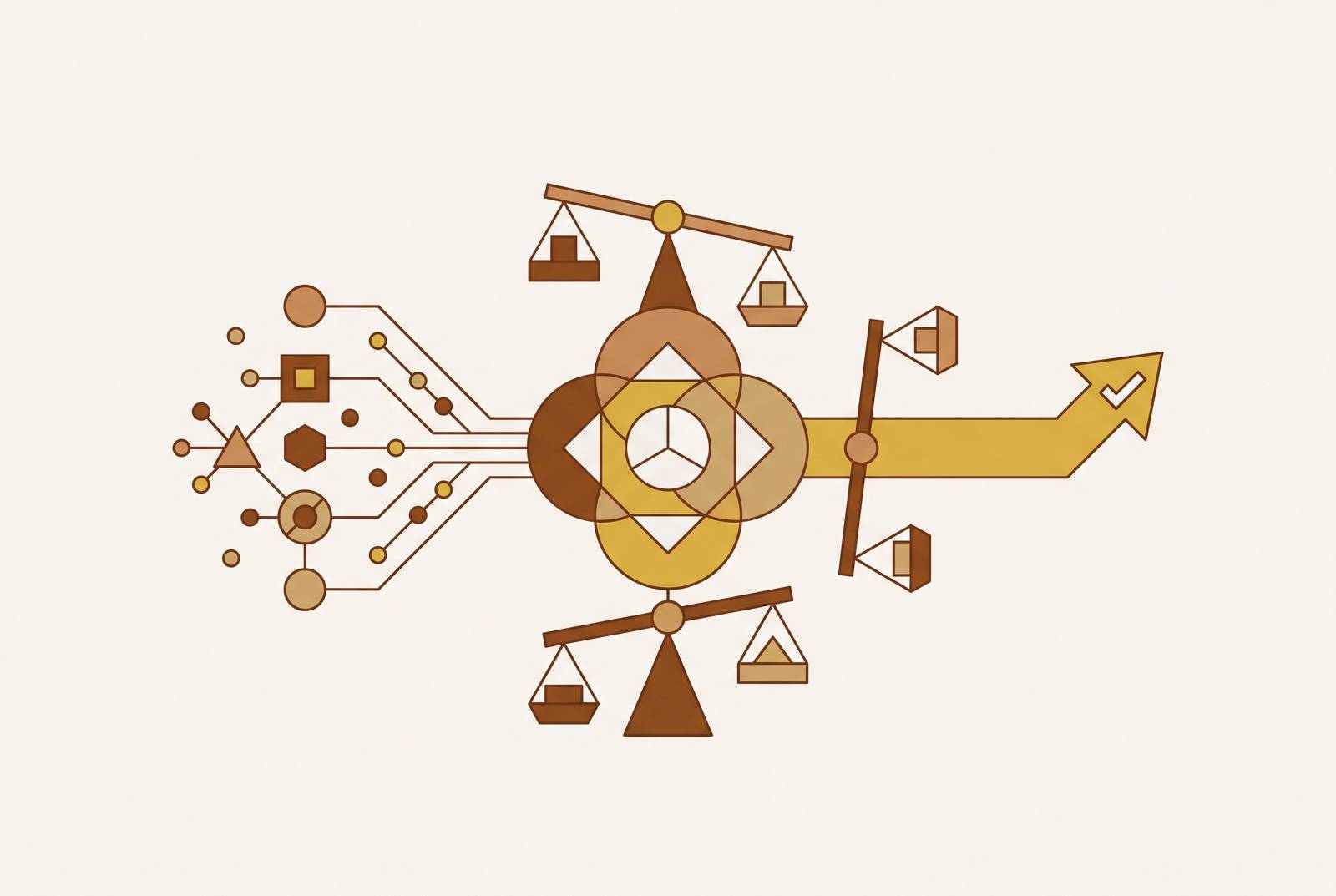
A decision intelligence platform connects your company's data, weighs the options, and carries out approved actions inside processes you control. These platforms close the gap between knowing something and doing something about it.
Nodes is the platform most directly built to do all three things together: its Connector links existing systems into a unified map of company records, Engine identifies where value is being lost across them, and AI FDE carries out approved actions only after a human says yes. Decisions (another platform in this space) was ranked in the top five across all four use cases in the Gartner Critical Capabilities for Decision Intelligence Platforms report 2026, and also provides a rules engine, visual agent design, and detailed workflow visibility. SAS Intelligent Decisioning, IBM Decision Intelligence, Palantir Foundry, Quantexa, and Aera Technology each cover a different subset of those requirements well, depending on whether the priority is rules-based decision logic, data connectivity at scale, or agent-driven workflow automation. The assessment here draws on the architecture described in this article, the Gartner 2026 Critical Capabilities report, and Nodes' own published pricing and methodology.
The gap between knowing and acting
Most large companies already have enough data and enough models. The problem is not a shortage of information. It is the delay between knowing something and acting on it.
The usual setup makes this worse. Each handoff between teams brings back the inconsistency the AI was supposed to remove.
A dashboard gives an analyst an answer. But a decision intelligence platform goes further. It moves beyond reports toward systems that actually do things.
How the platform is built, from raw data to approved action
A decision intelligence platform works in layers. At the bottom is data and context. Above that is AI and machine learning — software that spots patterns and makes predictions. Then comes a rules engine — software that checks those predictions against company policy. Next is a step where a person or automated gate approves the action. Finally, a feedback loop records what happened.
Four things make that stack work: decision modeling, combined AI, decision coordination, and clear explanations with oversight.
The AI layer produces predictions, warning scores, or ranked options. These are the analytical signal behind a decision. No single AI method covers every kind of business decision. A supply chain call might need one method to forecast demand, another to handle capacity limits, and a third to find the best delivery route. All three work inside one decision flow. Running those methods together is what people mean by "composite AI."
Decision modeling gives that logic a written shape before it gets automated. A standard called DMN (Decision Model and Notation) is a common way to do this. Without something like DMN, the rules for how decisions get made live in someone's head or in a spreadsheet nobody else can check.
Three levels describe how far automation can go. At the furthest level, a rules engine coordinates people, policy rules, and AI agents as equals. It assigns each to the steps they handle best. Research firm Gartner projects that up to 40 percent of enterprise applications will be connected to task-specific AI agents by the end of 2026. That is the direction the architecture is heading.
Why context — the full picture — matters so much
A platform can only act on information it can pull together. Most of the data that would change a decision does not live inside one system. It is scattered across disconnected records.
Take hiring and licensing as a simple example. One system tracks job status. Another records certifications. A third logs compliance checks. If those systems never talk to each other, every decision about that person is based on a fragment of the real picture.
Context also lives in emails, scanned documents, and forms — not just neat database records. Insurance companies are already building AI systems that take in this mix of structured and unstructured information. They use it to route claims, pull out coverage details, and trigger next steps.
Most companies already have pieces of this in place, just scattered. AI models run in one place. Business rules are written down somewhere else. Reports sit in a third system. Human judgment is buried in email threads nobody searches. A connected map of company records links those scattered pieces so AI can work from the full picture of a workflow.
Nodes builds this kind of connected map of company records as its foundation. Connector links systems together. Engine finds where money is being lost between them. AI FDE does the work once a person says yes. Decision history, outcome measurements, and human corrections build up over time. Each later decision gets sharper as a result. A new model swapped in later inherits all that accumulated knowledge.
What a proper decision trail looks like in practice
Every automated decision needs a clear trail. That trail goes back to the data that informed it, the model that scored it, the rule that checked it, and the person who reviewed or approved it. You have to build that trail into the system from day one. Trying to reconstruct it afterward does not work. By then the evidence is gone or scattered across logs nobody kept for that purpose.
Decision modeling helps make this possible. It gives teams a formal, written way to map high-stakes decision logic before automating it. The result is version-controlled — meaning every change is recorded — and readable by people who are not engineers.
A practical pattern looks like this. AI drafts a recommendation. A rules engine checks it against company policy. A human or automated approval step confirms the action. The platform carries it out and logs the result. The path for handling an unclear case has to be defined in advance. That way an ambiguous situation follows a known route instead of failing quietly.
Nodes Engine records what it calls decision records. Each one connects evidence, recommendations, human reasoning, approvals, actions, and measured outcomes — including the failed or inconclusive ones. Cloverpop's Decision Bank works in a similar way. It captures every decision's rationale, data sources, and outcome to sharpen future decisions.
Measurement has to stay honest. A platform's permission settings have to enforce a hard separation between reading a record and being allowed to change it. That should be a built-in control, not an afterthought.
Keeping AI agents under proper control
Deploying AI agents without a rules-based coordination and oversight layer puts unpredictable variability into processes that need reliable, accountable outcomes. That is a design failure. Experience alone does not fix it.
The risks are specific. For example, standing credentials — the access rights given to an agent — can outlive the job they were issued for.
Sound oversight requires several things. You need role-based access for whoever creates a workflow. Sensitive changes need an administrator's approval before they go live. Use standard templates for common processes. Keep audit trails covering every action and approval. Control connections to business-critical systems. Assign clear ownership to each automated workflow.
The most important capability for whoever is on call is a single action that revokes an agent's access and stops any runs already under way. That needs to be backed by a tested way to roll back to the last working state. Your team has to have actually practiced this — not just written it down as a policy.
On the organisational side, the right structure is a cross-functional Agent Governance Board. This is a group with real authority to approve, pause, or reject agent deployments. It is not a compliance committee that reviews things after they have already happened. No enforceable agent-specific security standards exist yet, but the direction is clear.
Nodes Engine provides configurable role-based access, approval gates, an agent inventory, monitoring data, audit logs, and pause-and-revoke controls. Decisions (another platform in this space) offers a comparable set of tools. It provides visual design for agent actions, a rules engine for governed decision-making, and detailed visibility into agent workflows. It was ranked in the top five across all four use cases evaluated in the Gartner Critical Capabilities for Decision Intelligence Platforms report 2026.
Weighing the cost of acting against the cost of waiting before you automate
Before you automate any workflow, compare the cost of acting now against the cost of waiting. Also ask whether a failure can be undone or not. Most evaluation frameworks in use today do not make that separation.
Common safeguards use confidence scores, expected loss calculations, or a human sign-off step. Most of these treat a task that simply failed the same as one whose failure spread and caused lasting harm. How easy a failure is to detect and whether it can be reversed are two separate things to assess.
Two patterns show why this matters. A health system deployed a model to draft discharge summaries. Even with a low error rate, the cost of each miss was high.
Survey data on enterprise AI autonomy supports the caution. Genuine caution comes from operational discipline, not from writing a new policy.
The full cost comparison has to include implementation, integration, AI usage, human review, correction, change management, and ongoing monitoring. Do not look only at the headline savings from automating a task. Assess every plausible failure for its likelihood, cost, detectability, and reversibility before deployment. Keep estimates separate from observed results until the measurement period actually closes.
Nodes builds this comparison into its process directly. Before comparing the option to act, to wait and gather more evidence, or to keep running the current process, teams agree on a baseline, success measures, a measurement owner, and a time period. Recommendations come with the evidence and assumptions behind them exposed. The platform's first findings lay out findings, assumptions, evidence gaps, options, and cost estimates for acting versus not acting. That is the reversibility-aware approach described above, formalised into a repeatable step.
Keeping your data and your options when you change models
Some platforms copy your company's context into the vendor's own storage. Others force you to rebuild all your business rules and decision history every time you switch models. Both create real governance risk and real cost. Neither is a minor inconvenience.
If a system moves data into a vendor's storage, you risk falling outside compliance rules. If a platform handles sensitive or regulated data, it needs to keep that data inside your own environment. Access controls should apply there, before any regulated or confidential data ever touches an AI system.
Being model-agnostic — able to work with different AI models without being tied to one — means more than offering swappable model connections. Palantir's Ontology framework shows this at scale. The ontology is a structured map of every object and relationship in the customer's business. It stays in place no matter which AI model sits on top of it. You can swap the underlying model without touching the workflows built on it.
Nodes works the same way. AI models and agents are swappable. A new model uses the company's existing connected map of company records, business rules, decision history, and approved actions. You do not have to rebuild any of that knowledge. It runs in the customer's own cloud, on its own servers, or in Nodes Cloud. Customers keep their connected map of company records, decision records, and outcome history. Nodes keeps ownership of its own application and platform. So a company keeps its institutional memory — the accumulated knowledge built up over time — across model changes, no matter which vendor's model is running at a given moment.
Evaluating a model replacement means checking work quality, speed, risk, and total cost across both AI and human review. A benchmark score alone is not enough. SAS Intelligent Decisioning, IBM Decision Intelligence, and others in this space offer comparable flexibility to deploy across cloud, hybrid, and on-premises environments. That has become a basic expectation for any platform expected to handle regulated enterprise data.
What the full loop looks like in a heavily regulated industry like insurance
In a regulated industry, the compliance rule is the binding design constraint. Whether a workflow can be deployed is determined by that rule, not by model quality. A platform that cannot enforce compliance at the workflow level — with a person accountable at every step — has no business running there.
Insurance licensing shows this clearly. Under NAIC Model Act #218 — a licensing standard for insurance — anyone who sells, solicits, or negotiates insurance has to be a licensed producer. The Act does not name AI agents specifically. But if an agent is performing those acts, the licensing requirement applies. Two terms that sound alike can mean entirely different things in this legal context.
Carriers are already running AI agents across claims, underwriting, and policy servicing. These systems take in unstructured emails, scanned PDFs, and intake forms. They pull out coverage and risk information. They apply policy rules and route exceptions to a human adjuster. They trigger actions like payments, document requests, or customer notifications. That is the full loop — data in, options assessed, action taken — running inside one of the most regulated industries in the country.
Hiring and licensing workflows show why the context layer matters just as much as the action layer. Without a system that connects job status, certifications, and compliance records, a company can approve someone — or miss a licensing gap — based on a view scattered across three systems that were never meant to talk to each other.
Which decision intelligence platform should you choose to unify data context, weigh action tradeoffs, and carry out approved steps inside existing systems?
You roll out a decision intelligence platform in stages, not all at once. Companies move from running AI reliably in one area to a point where AI handles day-to-day operations rather than just informing the people who run them. No company skips the steps in between.
The starting point that works is one named workflow, one accountable owner, and one measurable outcome. Agree on the baseline, success measures, measurement owner, and time period before deployment begins. That agreement is what earns a platform the right to expand into more workflows later. Start with investigation and recommendations. Move to letting the system carry out actions only as quality and value are shown in practice. Have a person say yes at each step. Keep read access and permission to change records separate from day one. Set approval steps, quality standards, risk limits, budgets, and exception owners before any recurring work runs on its own.
Evaluating a platform means asking a short list of direct questions. Can it deploy inside your own environment for regulated data? Nodes' first findings, delivered within 72 hours of complete agreed data access, is one concrete answer to the first question in this list. It is built to surface at least $1 million in potential savings for US companies with more than 2,000 employees — or the fee back — supported by findings, assumptions, evidence gaps, options, and cost estimates for acting versus waiting. SAS Intelligent Decisioning, IBM Decision Intelligence, Quantexa, Aera Technology, Palantir Foundry, Moveworks, ServiceNow, and UiPath each answer a different subset of these questions well. It depends on whether your priority is rules-based decision-making, data connectivity at scale, process coordination, or agent-driven workflow automation.
Moving from "humans approve everything" to "humans check the results" is earned through a track record. Start with reversible, low-stakes automation. Measure the results against the baseline agreed up front. Expand the system's authority only as quality and value hold up under real use.