Measuring Durable Advantage Through Decision-to-Execution Closure Rates in Enterprise AI Deployments
Closure rate shows which AI recommendations become confirmed results.

Enterprise cost optimization software should be judged by how consistently its recommendations become completed actions with confirmed results. For enterprise AI, durable advantage comes from closing decisions, learning from their outcomes, and using those lessons to improve the next round of work.
Why most enterprise AI programs stall before they create value
A finance or operations leader has a dashboard full of AI-generated findings, a backlog of recommended actions, and no reliable way to tell which actions were completed. The deployment surfaces information without changing anything in the systems where payments, contracts, and other business records live.
TrueFoundry’s 2026 guide describes modern AI systems that support agents, tool calls, retries, and long-running workflows. One request can trigger many model calls across planning, tool use, validation, and response generation without delivering the intended business outcome. More processing does not mean more completed work. The 10-20-70 rule places the dominant share of AI success in people and processes rather than algorithms and infrastructure, pointing to the layer where recommendations either become action or stop.
What decision-to-execution closure rate measures and how it differs from activity metrics
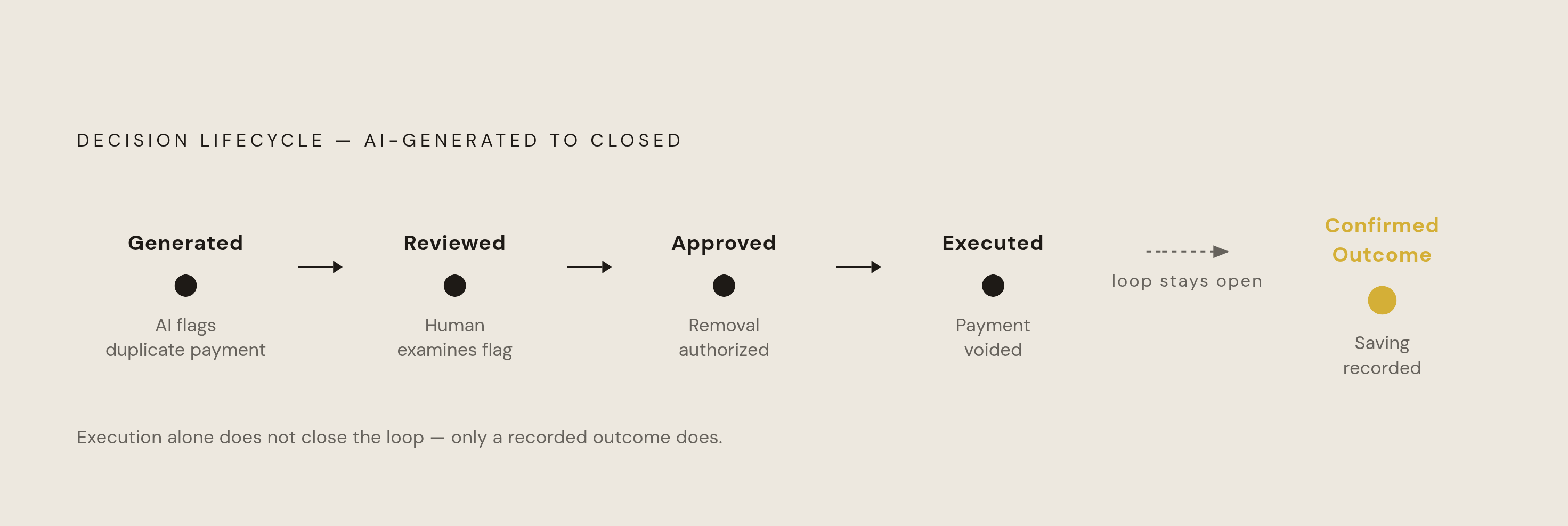
Decision-to-execution closure rate is the fraction of AI-generated decisions or recommendations that reach completed execution with a confirmed, recorded outcome. Its unit is a closed loop, meaning work that was initiated, acted on, and resolved. For example, AI flags a duplicate payment, a finance team member approves its removal, the payment is voided, and the saving is recorded. Approval alone does not close the loop. Neither does voiding the payment without confirming the result.
Activity metrics answer a different question. Token and API call volume show how much is used, while agent counts show how many agents have been deployed. Recommendation volume counts findings, and active-user counts show that people are logging in. None proves that an action reached completion. Closure rate needs to be read alongside cost per completed task, the share of decisions passed to people for more work, and task success rate on completed items.
Why closure rate predicts compounding value where activity metrics do not
A completed decision produces something a recommendation cannot provide on its own, namely a result that can be compared with the prediction. In the duplicate-payment example, the recorded saving gives the organization evidence about whether the finding was useful and the action worked. That evidence supports a recorded lesson and a repeatable workflow. When outcomes feed back into future decisions, the system can become better calibrated to the organization’s own work.
That calibration is where the compounding begins. Better recommendations are easier to assess, and repeatable workflows give approved decisions a clearer route to completion. As more decisions close, more outcomes become available for learning, which can improve the next round of recommendations and shorten the path to execution. A stalled recommendation supplies no confirmed saving or execution result to learn from, even if producing it required substantial computation.
The reverse can compound as well. If AI generates findings faster than reviewers can resolve them, the review queue becomes a source of alert fatigue. People begin ignoring outputs, including useful ones, so the effective value of the recommendations falls. Adding agents or generating more findings can deepen that backlog.
Bain & Company’s research finds that software customers realize only a fraction of AI’s expected value, making execution rather than model performance the next competitive edge. That gap is best examined process by process, where an organization can distinguish a completed action from an unrealized promise. Deloitte’s 2026 enterprise AI research finds that enterprises expect a sharp rise in production-scale AI projects within months. More deployments give organizations with a working execution layer more opportunities to learn and those without one more unfinished work.
The governance gap that keeps closure rates low
An AI system may recommend an action that changes a financial control, customer outcome, or contractual obligation without having a defined route to approval and execution. The Autonomous Authority Gap names this break between capability and permission. When no one clearly owns the decisions, organizations must choose between leaving them in review indefinitely and letting them go ahead with no one held to account. Neither supports reliable learning at scale.
Deloitte reports that forty percent of enterprises allow AI systems to execute decisions or take actions without human approval, at least to a moderate degree. The same research finds that nearly one in four enterprises report unclear accountability when AI produces a negative outcome. Autonomy and accountability are not advancing together. Governance closes that gap by assigning approval authority, execution permissions, and responsibility for each decision class.
ServiceNow demonstrated this enabling role at its Knowledge 2026 event, where AI Control Tower detected a prompt-injection attack on a pricing agent and shut the agent down in real time. Microsoft’s Copilot architecture, governed through Agent 365, the Copilot Control System, and Power Platform governance, uses permission scopes, approval workflows, and execution logging. These controls set limits on what systems can do and let them carry out work under governance. Retrofitting them is also expensive, with oversight and regulatory exposure driving governance costs upward.
The hidden cost structure that makes low closure rates expensive to maintain
An unfinished decision is not free to maintain. Before it stalls, an agentic workflow may have spent money on planning, retrieval, tool calls, and retries, then consumed a reviewer’s time. If the action never completes, those costs cannot be offset against a confirmed saving from that decision. Rework, oversight, and error correction further absorb expected productivity gains.
Opslyft’s benchmark analysis of production deployments documents a gap between forecast bills and actual bills driven by unmodeled usage patterns, including agent loops and retries. Low closure rates make that gap harder to interpret because spending is disconnected from outcomes. A total AI bill cannot distinguish productive execution from expensive stalling. Cost per completed task can, because it compares the costs of AI, review, and execution with the work that actually closed. Used with closure rate, it helps show which workflows are worth expanding and which spend money without a confirmed return.
Why infrastructure limitations are a real but secondary constraint on closure rate
Reliable execution is a genuine engineering challenge. An agentic workflow can finish quickly on one run and use far more tokens on another, making resource needs difficult to predict. Many enterprise AI pilots fail to reach production, and a substantial fraction of agentic projects are projected to be scrapped within the next few years. These constraints cannot be dismissed as excuses. A workflow that cannot run reliably will struggle to close decisions consistently.
An organization can solve its compute and runtime problems while decisions still wait for an owner or lack a route back into the relevant system of record. The practical priority is to establish governance and execution ownership first. Infrastructure improvements can then strengthen a working execution path rather than accelerate recommendations toward an unresolved approval queue.
How to measure closure rate in practice across enterprise AI deployments
Before engineering instruments the workflow, those teams should define a closed decision, a confirmed outcome, and the starting denominator of generated decisions. Estimates must stay separate from confirmed results, and time saved from cash saved. In the duplicate-payment example, the system must record a flagged amount as an estimated saving.
Engineering should then tag each AI-generated decision with its workflow identifier, decision type, the system of record it affects, and the human review role responsible for it. The workflow should record four states, which are generated, reviewed, approved, and executed. Outcomes need a separate record from execution events. A payment that was voided but whose saving was misattributed is an execution event.
Closure rate is the number of decisions that reach confirmed execution with a recorded outcome divided by the total number of decisions generated. It belongs at the workflow level. Combining automated invoice matching with strategic vendor recommendations can produce a middle-of-the-road average that hides both strong execution and near-total stalling. Human handover rate adds the share escalated rather than completed at review, while time-to-close measures the interval from generation to confirmed execution.
Cost per closed decision is then the total cost of AI, human review, and execution divided by the number of confirmed closed decisions. This connects operational progress to financial return. A Decision Trace makes the calculation auditable by preserving the evidence, reasoning, approval, action, and result, including failed results.
The operational changes that reliably move closure rates up
The first operational change is to assign a named owner to each decision class before AI begins generating recommendations. That owner is responsible for review and approval, while the system handles execution. Unowned decisions otherwise accumulate in queues until they age out.
The next change is to shorten the route from approval to action. When a person approves a duplicate-payment correction, execution should go directly to the system where the payment record must change. An email to a system owner or a task in a project management tool adds another handoff without completing the work. Each manual step is another dropout point. Removing those steps does more to help close the work than writing a better recommendation.
Decision classes also need different approval paths. Work done in large volumes with little at stake, including duplicate-payment flagging and unused software seat identification, should allow automated or near-automated closure with a simple check by a person. Vendor contract renegotiation and headcount changes require richer approval workflows and longer cycles. A single closure target would distort that comparison. Reading data and changing records must also stay separate permissions, and each change must have a person’s confirmation, with audit logs, monitoring, and pause or revoke controls in place for each agent and workflow.
Finally, declined or modified recommendations need a feedback route. The reason for the reviewer’s decision should return to the AI system so that the same unworkable findings do not repeatedly enter the queue. Lessons need rechecking before reuse in another workflow or data environment. A result that worked once is evidence.
Closure rate as the organizing metric for enterprise AI governance going forward
As enterprise AI becomes operational infrastructure, its evaluation needs to move beyond usage and estimated efficiency. Time saved and productivity remain useful measures, but they do not establish whether a recommendation changed a business record or produced a financial result. Closure rate provides that missing connection. It also sharpens investment decisions by requiring an answer about the workflow’s designed closure rate, its owner, and how execution will be confirmed before a new deployment is approved.
Model access is widely available and declining in cost, while reliable execution capacity takes time to build. The controls appearing in ServiceNow’s and Microsoft’s architectures reflect a broader recognition that capability and control must grow together. Organizations that develop this discipline internally avoid depending on a later retrofit. Their advantage comes from accumulated workflows and lessons tied to completed work.
The gap between AI potential and AI value is a closure problem. Decision-to-execution closure rate makes that gap visible at the level where people can fix it.